I am supposed to be getting some of this steel soon but I wanted to write up an analysis of the composition first. There was an article from BladeHQ about the steel and also a video from TKell Knives so I have gotten some questions about it.
Background
I was able to talk to Robert Buck, the developer of these steels, so when I got an answer to questions I had I will provide it, otherwise the following is my own analysis and speculation and shouldn’t be construed as anything official. Thank you Dr. Buck for speaking to me about the steel!
Carpenter’s A-421 knife steel actually started out as A-21 steel, which is the only version of the product that currently has a page on Carpenter’s website: https://www.carpentertechnology.com/alloy-finder/a-21
Here is the composition of A-21 according to the data sheet:

There are a bunch of ranges and maximums so here is the simplified composition using averages of each range. I also included A-421 which is the same apart from the carbon content. I will explain where I came up with the carbon content of A-421 shortly.

These grades were developed by Robert Buck, with A-21 patented in 2005 [1] and A-421 patented in 2024 [2]. I also found that Dr. Buck patented another steel in 1994 that is similar to A-21 but with a significant cobalt addition [3]. I asked Dr. Buck if this cobalt-alloyed version was ever commercially produced but he said that A-21 was the first to be available. The main unique thing that is discussed in each of these patents is the use of titanium. Titanium is relatively common in modern low alloy steels as a microalloy element, typically under 0.1%. It is relatively rare in tool steels and knife steels, however. Titanium forms a hard TiC carbide that can contribute to wear resistance in a similar way to adding niobium (Nb) or vanadium (V). The precursor patent says [3] that the titanium addition and the resulting TiC are used because they are “much smaller than the relatively large (0.1-0.3 μm) Cr-rich carbides” that they “precipitate homogeneously throughout the bulk material, rather than primarily on lath or grain boundaries,” and that they “do not coarsen appreciably during long term holds at high creep temperatures to about 700°C. Thus, the average interparticle spacing is small and remains so during creep.”
A-21 Stainless Steel and Titanium
A-21 was designed to be a martensitic stainless steel that is “fine-grained” due to the “relatively uniform dispersion of coarsening-resistant, MXX-type precipitates.” In other words, to have a small grain size due to TiC. A dispersion of small, stable carbides will “pin” grain boundaries thus slowing their growth and keeping the grain size small. Titanium can be a good element for this because the carbides will not dissolve until very high temperatures.
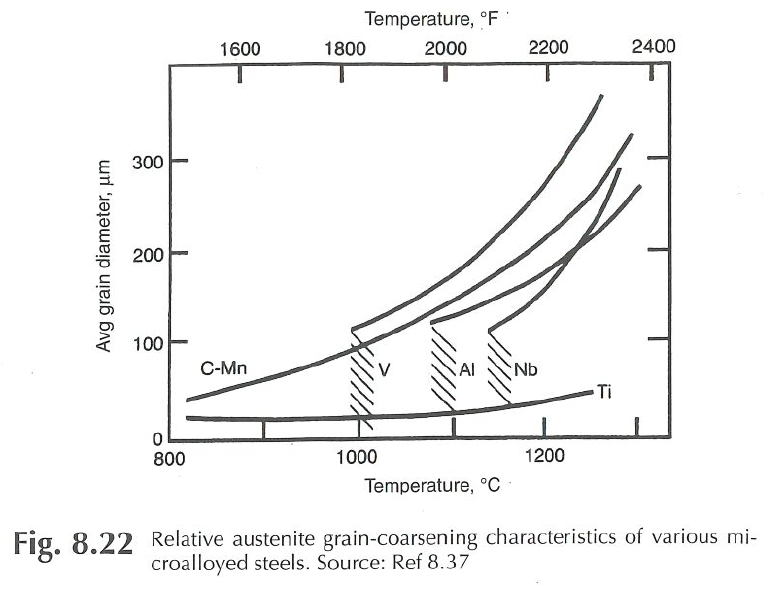
The chart above is for microalloy additions. Vanadium or niobium could pin grain boundaries to even higher temperatures if they were added in greater amounts. But for small additions, titanium works up to the highest temperatures. On the flip side, the titanium carbides form in the liquid during steelmaking and can become very large. The patent says [1] that Ti is restricted to 0.75% to “minimize the formation of primary MX particles.”
Corrosion Resistance
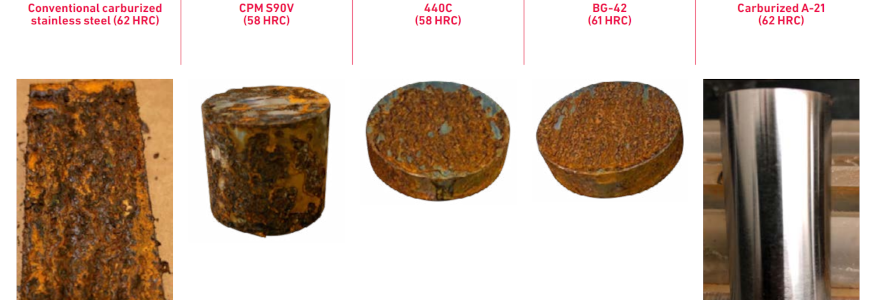
The A-21 patent does not mention carburizing, but the product seems to have evolved in the intended use because the Carpenter website describes it as a “stainless carburizing steel.” Carburizing is the process of adding carbon to the surface of steel by heating it in the presence of a carbon-containing gas like carbon monoxide. That makes the surface harder and more wear resistant. The data sheet even says that A-21 is “the world’s first and only truly stainless carburizing steel” which is an interesting claim. Other stainless steels have been used for carburizing in the past, and the steel is not so unique that other steels could not be used in a similar way. I think what it means is that A-21 is “truly stainless” meaning having improved corrosion resistance compared to prior carburizing alloys. So at some point it seems they determined that A-21 had more potential as a carburizing stainless steel than only using it in the quenched and tempered condition. The data sheet has a picture showing its excellent corrosion resistant compared to high carbon stainless steels:
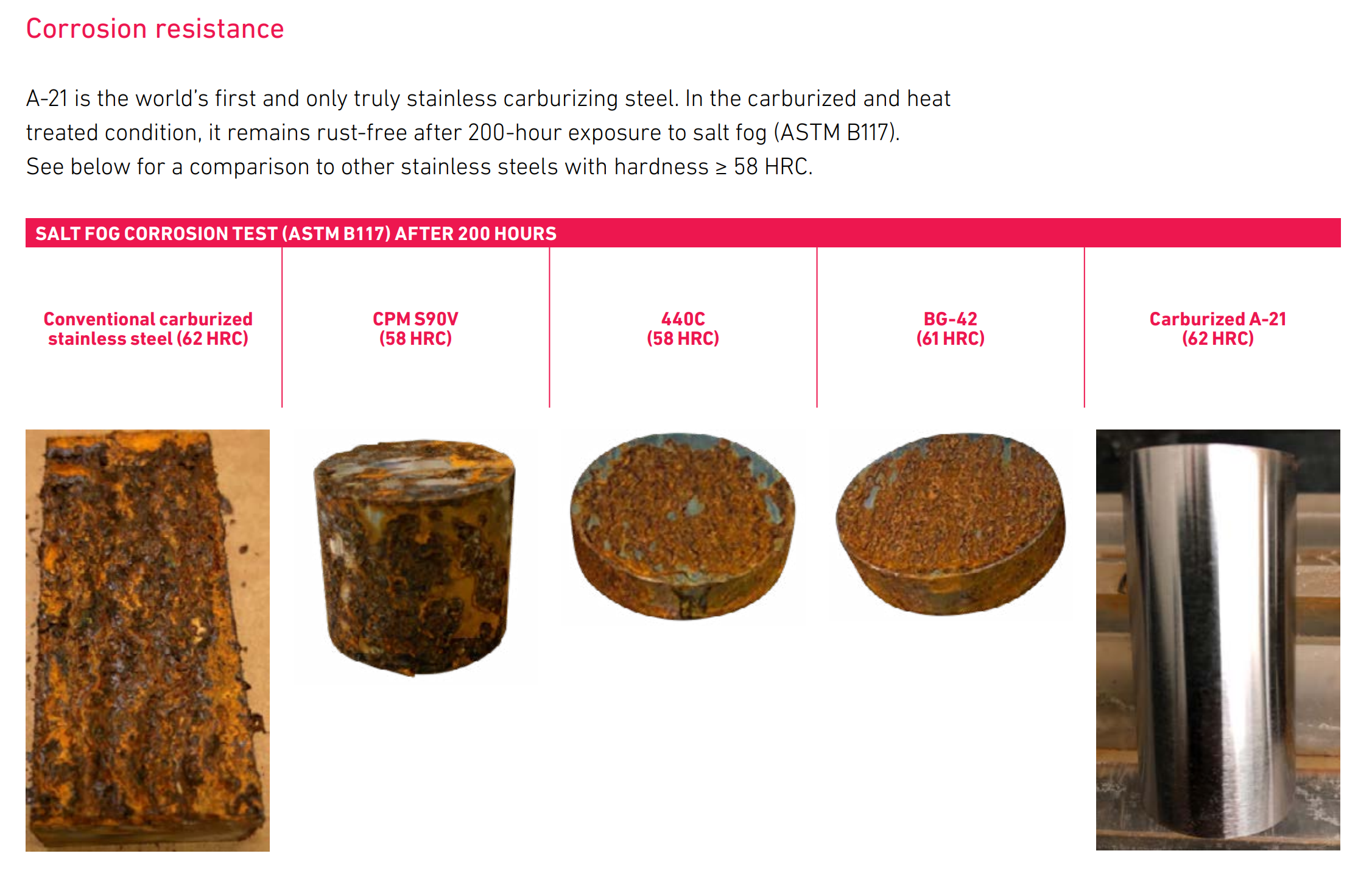
None of those comparisons are particularly high corrosion resistance steels, but it is still an excellent result. A comparison against Cronidur 30/LC200N would be interesting, for example. The patent mentions Cronidur 30 but I did not see any direct comparisons against its properties other than for hardness. The data sheet says the steel tops out around 36 HRC without carburizing, but with carburizing can be heat treated above 60 HRC. The patent does acknowledge the existence of prior stainless carburizing steels such as Pyrowear 675 and CX13VDW but it says that those grades do not exhibit good corrosion resistance. Those grades are relatively similar to A-21, apart from the use of vanadium rather than titnaium.

What is the chromium content?
You’ll notice that I changed the chromium content of A-21 in this table above to 11 with a question mark, rather than the midpoint of the data sheet which was 12.25%. The reason is because the patents all show “examples” of A-21 which have less than 11% Cr (10.66, 10.83, and 10.86%), and because the patent says the difference between A-21 and those earlier steels is that the earlier ones will form chromium carbides and A-21 doesn’t. The way to do that is to reduce chromium, and CX12VDW already has 12%. So for that reason I believe the actual target chromium content of A-21 is 11% or perhaps even a bit lower. The average of the three “examples” in the A-21 and A-421 patents would be 10.78%, so a target of 10.75 or 10.8% would not be surprising, though when making one-off heats for testing purposes they are not always perfect, and there will always be some variation between a target and the final result.
Molybdenum, Titanium, and Microalloys
The midpoint of the data sheet spec says 0.6% for Mo but all of the patent examples are around 0.5% (0.47, 0.49, and 0.49%). The midpoint for Ti is 0.45% though all of the examples are lower: 0.37, 0.38, and 0.29%. So the target Ti is probably below 0.45%, perhaps 0.35%. Small differences in Ti can mean sizeable differences in the TiC which is why I am nitpicking the Ti amount. The A-21 patent has two examples, one without V or Nb and one with 0.03% V and 0.015% Nb. The A-421 patent lists an example with 0.1% V and 0.06% Nb. So I think they may be making microalloy additions for those two elements.
A-421 and Adding More Carbon
The method for adding more carbon to make A-421 has evolved since the patent to a more conventional method of adding it to the melt.
The patent says [2] that while the steel could be given a carburized surface the design is primarily for having carbon “throughout” the cross section, and adds about knives: “A through-hardened knife blade that utilizes the technology and methods described herein, for example, could be repeatedly sharpened without adverse consequences. This aspect of the invention has been successfully realized with thicknesses of about 0.09 inches to about 0.1 inches. However, it is believed that the invention can be extended to thicknesses up to about 0.125 inches or more.” So it appears that A-421 would be restricted to thinner cross-sections if it was produced with this carburizing manufacturing method.
Originally the patent claimed it was necessary to carburize the sheet to keep the size of the TiC small [2]: “The carbon content of the alloy according to the present invention cannot be obtained conventionally, such as by adding carbon during melting because such an alloying addition would result in a relatively large volume fraction of primary MC particles with a large interparticle spacing…” This is an interesting method and not one I have heard of before, I am only aware of carburizing final parts, not whole steel sheets. It reminds me some of the process Uddeholm uses by nitriding their steel powder to make Vanax or Vancron. But in this case it is the whole steel sheet and not powder.
Interestingly, thermodynamic software does not predict a difference in the TiC formation temperature based on carbon content. This makes some sense; if there is enough carbon to form all of the TiC then the steel will form the same amount of TiC and thus the formation of those carbides should be relatively similar. This is significant because TiC will form at extremely high temperatures where rapid growth is possible. The software predicts a formation temperature around 2770°F. However, it is not totally implausible that producing the steel with lower carbon would lead to smaller carbides. If the thermodynamics of the carbide formation remain unchanged perhaps the “kinetics” (speed of formation) would be.
However, when I spoke to Dr. Buck he told me that the carburization method was not ultimately feasible and that they add the carbon when making the steel instead. I asked about keeping the carbides small and he said that by carefully controlling the composition and using some specific processing they are able to keep the carbide size in check.
The target carbon content is not published in any data sheet or presentation I have found, but ranges are given in the patent. The patent covers a range of 0.2-0.7%, the midpoint of which is 0.45% carbon. Later in the patent it says that hardness greater than 60 HRC can be achieved if the carbon content is between 0.35 and 0.63%, and the midpoint between those is 0.49%, which is why I have assumed the target carbon content is 0.5% for A-421.
Microstructure
There is a micrograph of A-421 which was published in a presentation that has been delivered around to different people but has not been published online by Carpenter. You can see images from it on Spyderco forums.
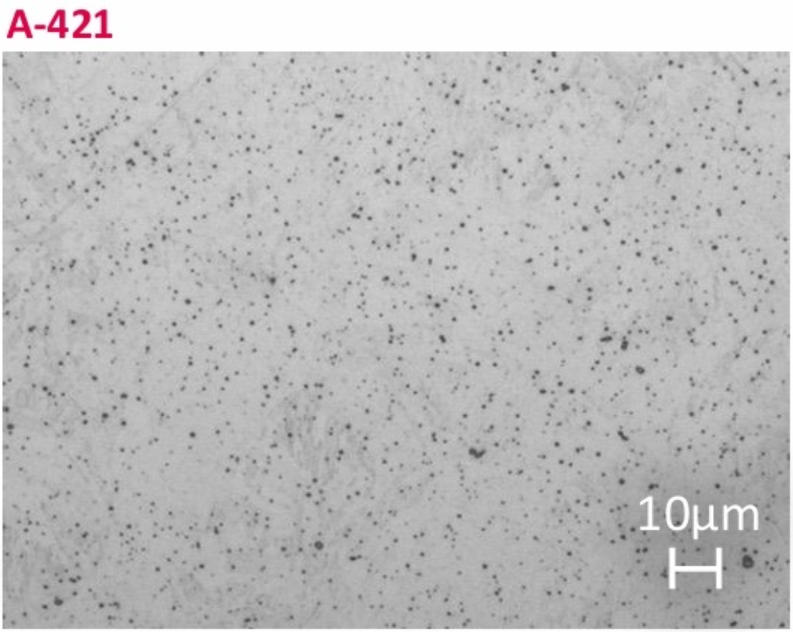
The micrograph shows relatively small TiC, the largest are somewhere in the range of 1-4 microns, which are the “primary” carbides that form in the liquid steel. There are also many smaller carbides which are the “secondary” carbides that form in the solid steel. And there are even smaller carbides that are only visible with electron microscopy. Technically these carbides could contain some nitrogen, either TiN or Ti(C,N), and also they could contain some niobium or vanadium. So sometimes metallurgists label these as “MX” where M is generic for a metal and X is for carbon or nitrogen. Though I don’t always refer to MX because it is more for metallurgists to be correct than to give real meaning to the person reading it.
I am not sure if this is a micrograph of the earlier carburized A-21 or if this is the final version where carbon was added to the melt. Thermodynamic software predicts about 0.8% MC from the Ti, V, and Nb. As a comparison, here are micrographs of 3V with 4-5% MC and MagnaCut with about 8%. Note that the magnifications are similar but not identical, and also the carbides appear black in the A-421 micrograph and white in the 3V and MagnaCut micrographs.
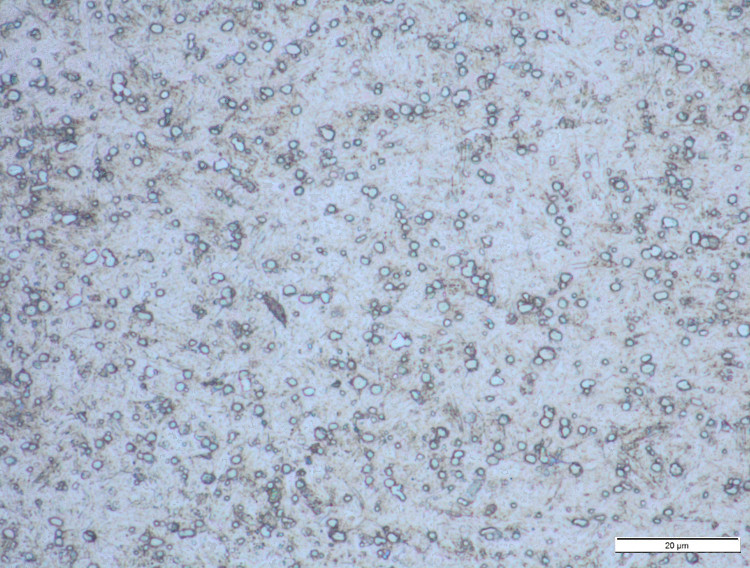
CPM-3V with about 4-5% MC
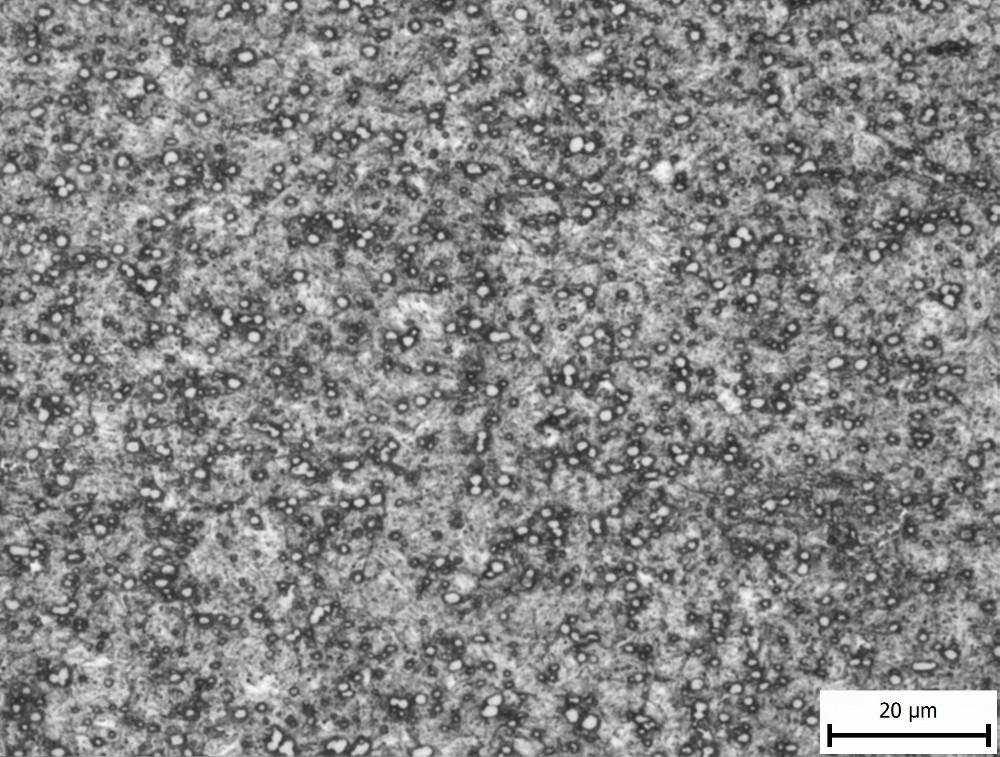
MagnaCut with about 8% MC
I am very curious to see more micrographs of the A-421. I have found journal articles [4-5] about steels with similar Ti contents and often the TiC particles are significantly larger than what is shown in the A-421 micrograph. So it would be an accomplishment of its own to be able to maintain the carbide size so small.
Predicting Properties of A-421
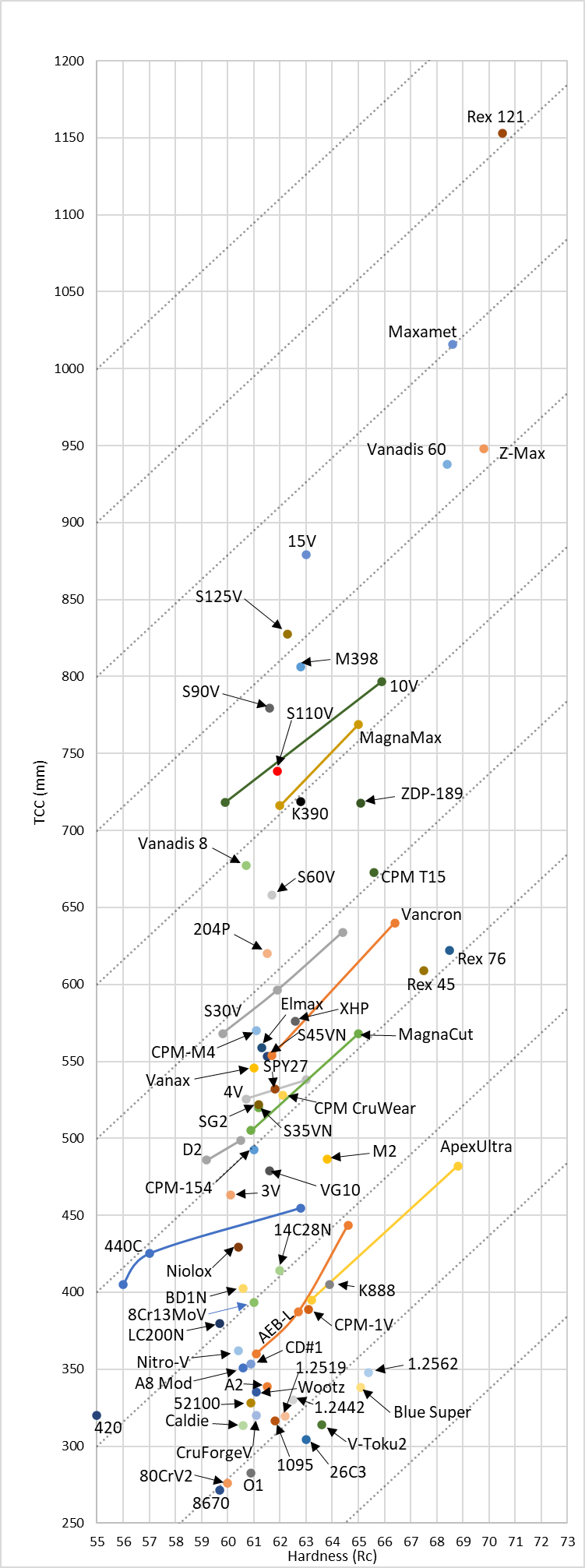
So using the information we have about A-421 we can make some predictions about its properties. To summarize what we discussed so far: around 10.8% Cr in solution, can be heat treated to roughly 62 HRC, has no chromium carbides after heat treatment, and has about 0.8% MC which are relatively small. Titanium carbide is high in hardness, even a bit harder than NbC [6]. Those all add up to a steel that should have very good corrosion resistance and toughness with relatively low edge retention. Z-Tuff and CPM-1V also have about 1% MC, though they also have 2-3% chromium or molybdenum carbides. So we would expect A-421 to have edge retention that could be as good as those steels, though probably a bit worse due to having less carbide. Those steels have similar edge retention to AEB-L as well, another comparison point for A-421 in terms of its potential toughness-edge retention balance. We would expect A-421 to have similar properties to LC200N having good corrosion resistance but with somewhat higher potential hardness. Or similar to AEB-L or 14C28N but with improved corrosion resistance. However, LC200N and 14C28N did have somewhat higher edge retention in my CATRA testing than AEB-L, CPM-1V or Z-Tuff (I tested CD#1 which is the same). I wouldn’t expect A-421 to exceed those steels for CATRA testing because of the low carbide content. The Carpenter presentation says “Outstanding edge retention as shown from CATRA testing” but doesn’t give any numbers or direct comparisons.
Fine Blankable?
Many knife steels cannot be “fine blanked” because they have too much carbide and/or are too hard in the annealed condition. Either the equipment does not have the power to blank out the knives or the blanks themselves will fracture during blanking. But fine blanking is important to low cost knives especially. It is a cheaper and faster process than waterjet or laser cutting. 420HC is perhaps the best known steel that is fine blankable, but some knives made with 12C27, 13C26, AEB-L, and 14C28N are fine blanked. One interesting thing I noticed in the A-421 presentation is that it said that it could be fine blanked but it also said the annealed sheet would be 302 BHN max. Of course that is a maximum, but that hardness is quite high for a steel that would be fine blanked. 420HC is reported to be 89 HRB by ATI which would convert to about 188 BHN, much softer than the reported max annealed hardness of A-421. And ATI reports 95 HRB (about 210 BHN) for 440A. For a hardness scale knife enthusiasts might be more familiar with, 302 BHN converts to about 32 HRC, relatively high for annealed hardness. Dr. Buck told me the current product is about 30 HRC in the annealed condition, but they have worked on the annealing procedure in the lab and have gotten as low as 25 HRC. I think that will still be significantly too high for easy blanking.
Conclusions
I like that A-421 is a relatively unique knife steel and that it uses a different composition approach from past steels. If it works out as intended it could offer very good toughness and corrosion resistance in a product being produced in the USA. The remaining questions I have about the steel are whether it can match the edge retention of steels like AEB-L or LC200N and if it falls short by how much. I also have my doubts about whether the steel will be truly fine blankable with the relatively high annealed hardness. And I am also intrigued to see micrographs to see just how small those titanium carbides are.
[1] Buck, Robert. “Fine-grained martensitic stainless steel and method thereof.” U.S. Patent 6,890,393, issued May 10, 2005.
[2] Buck, Robert F. “Strong, Tough, and Hard Stainless Steel and Article Made Therefrom.” U.S. Patent 12,129,536, issued Oct. 29, 2024.
[3] Buck, Robert F. “Creep resistant, precipitation-dispersion-strengthened, martensitic stainless steel and method thereof.” U.S. Patent 5,310,431, issued May 10, 1994.
[4] Kostryzhev, A. G., C. R. Killmore, D. Yu, and Elena V. Pereloma. “Martensitic wear resistant steels alloyed with titanium.” Wear 446 (2020): 203203.
[5] Li, Jing, and Chengbin Shi. Carbide in special steel: formation mechanism and control technology. Springer Nature, 2021.
[6] Bedolla-Jacuinde, Arnoldo. “Microstructure of vanadium-, niobium-and titanium-alloyed high-chromium white cast irons.” International Journal of Cast Metals Research 13, no. 6 (2001): 343-361.
