Patreon
Thanks to my new Patreon supporters for supporting knife steel research! Magellan117, 許晉誠, Nathaniel Walker, Mark, Christopher Thomas, Joab Stecher, Steven Lagace, Francisco, Adam Lowenstein, Chantal, Timothy P Wright, John Schmidt, DiSH, diddybob, Andy Orsburn, Kfir Behar, John, Jacob Knudsen, and Jacob E. You can also become a supporter at Patreon.com/Knifesteelnerds.
Video
There is a video version of the following article:
History of Knife Steel
I love learning how different steels were developed and which knife companies and knifemakers chose to apply them to knives. I did a huge amount of research for my book, The Story of Knife Steel, which covered all the “stories” about how all of that happened. If you want to know where I got the different dates and background information in the article below then read The Story of Knife Steel.
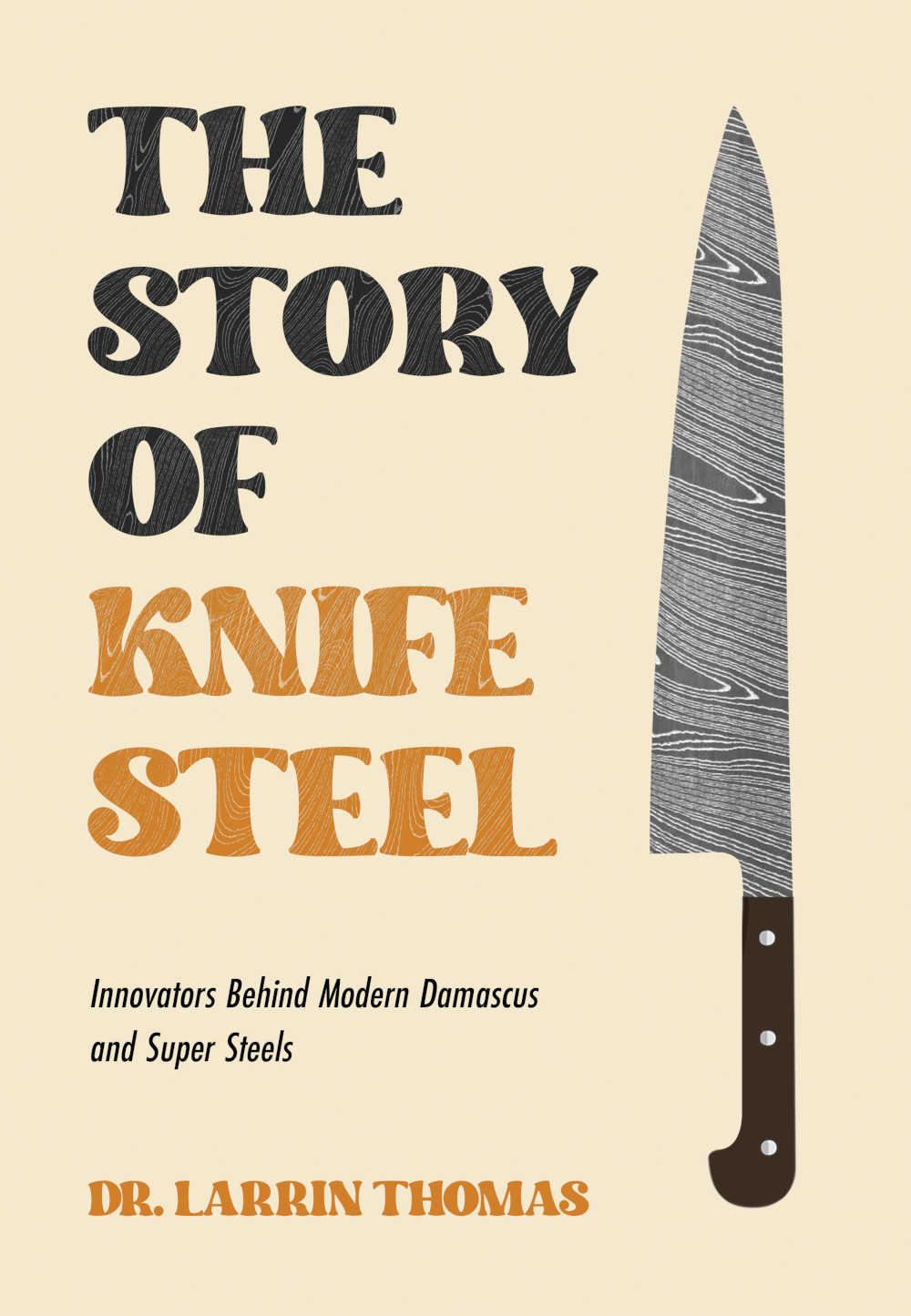
This article was originally twice as long as it is because I wanted so badly to include so many stories and tidbits, but to keep it manageable, I had to cut most of that. If you want to get all of that missing content, then read the book. There are also tons of pictures of old knives and fun ads for steels of years past.
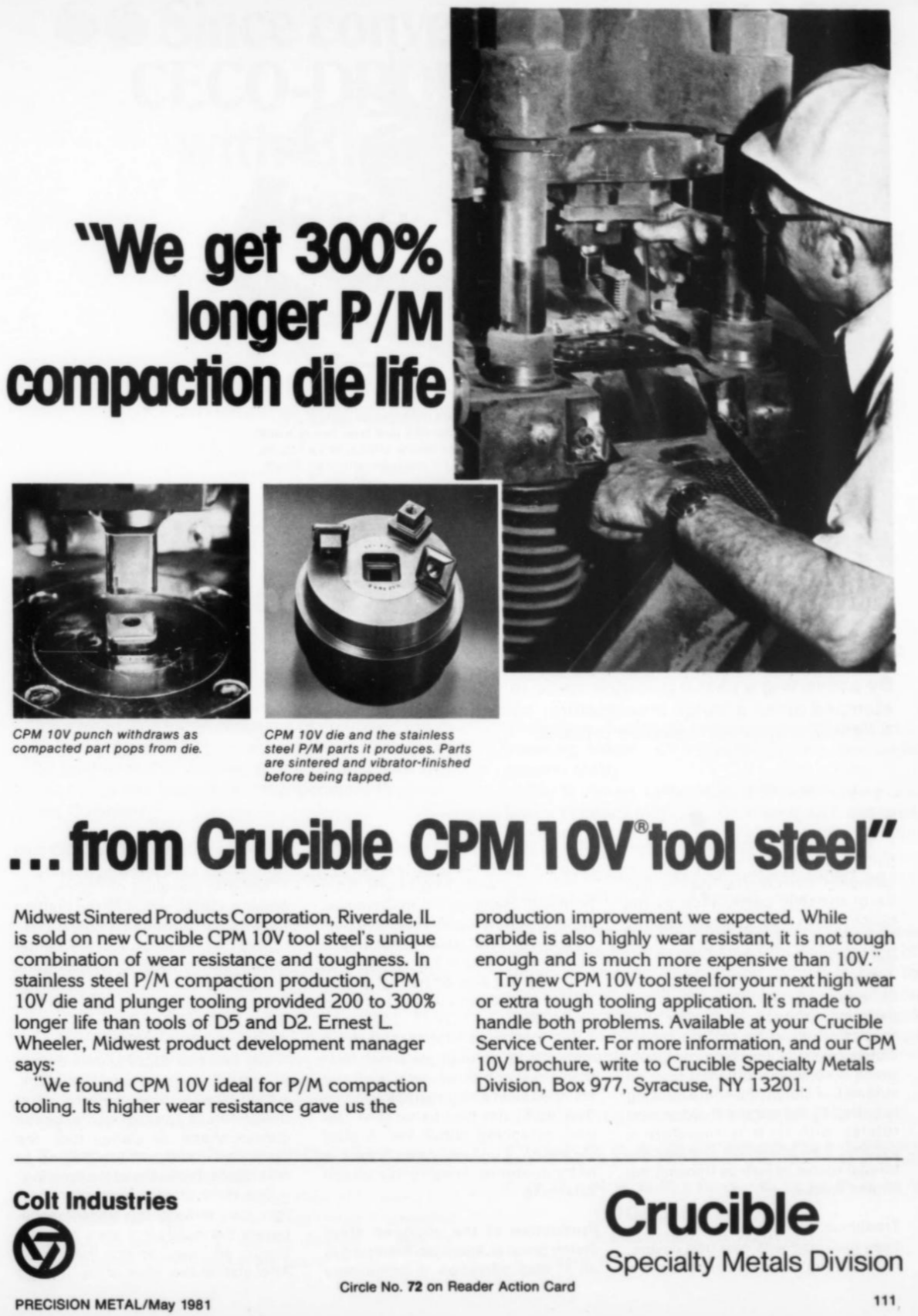
1981 ad for CPM-10V
Choosing Best Knife Steels by Decade
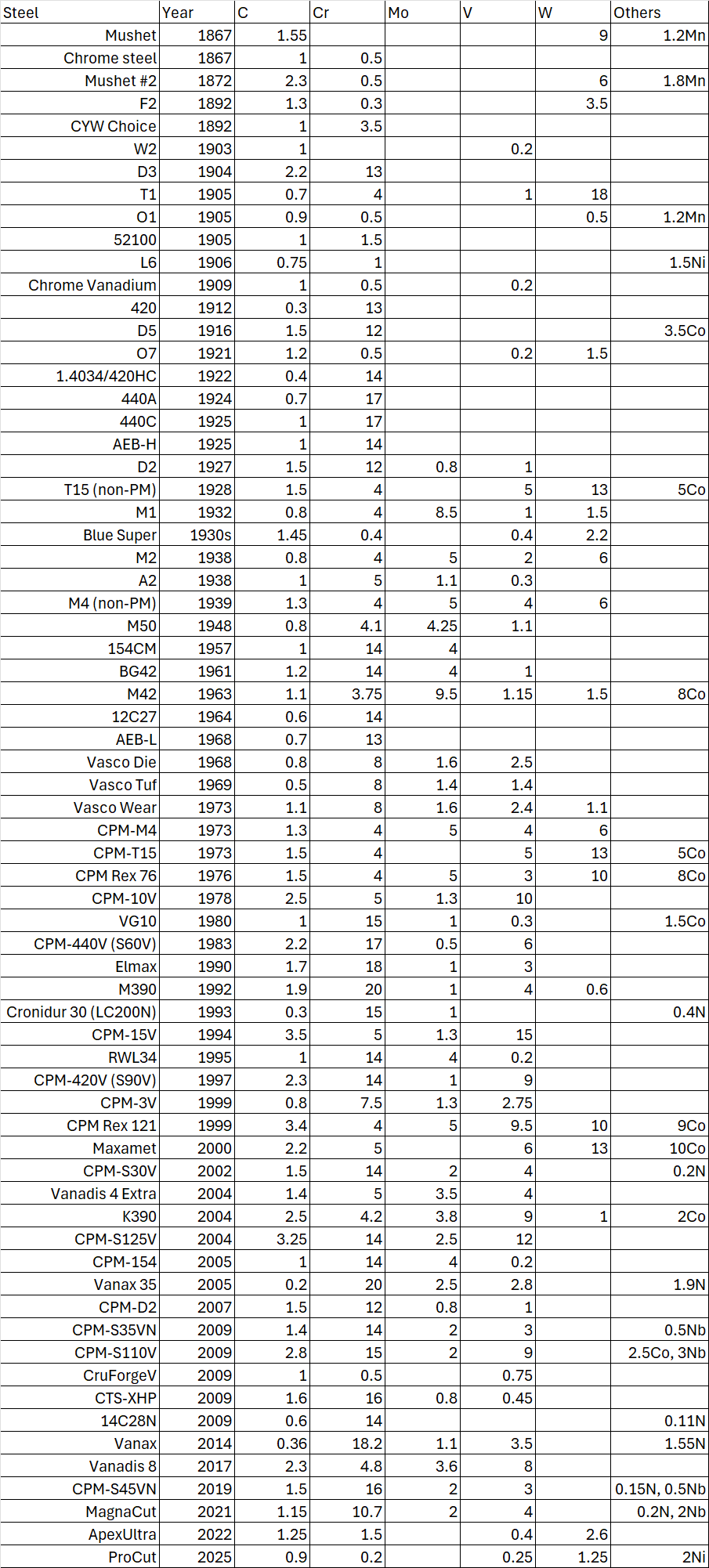
Below I have a table showing steels that were released in order of date, along with an approximate composition. You may notice that many of these steels were released quite a long time before they were actually used in knives. That is often because knifemakers didn’t learn about them until much later, though another important factor is that they often weren’t available in thin sheet and weren’t available in small quantities. So in this article I will be discussing what the best steels were that were actually being used in each decade, and what the best steels could have been if they had been popular in knives.
Knife Steel in the 1800s
In terms of alloys, by far the most common cutlery steel in the 1800s was simple high carbon steel. It is often reported that this was 1095 steel though it would be more properly called W1 tool steel. The differences are that W1 was somewhat lower in Mn, and also the carbon content for cutlery steel was sometimes higher than the 1095 spec allows (0.9-1.03% C). But they are similar enough that it is probably splitting hairs.
There was some experimentation with different steel alloys in knives, however. At the 1874 Mechanics’ Fair, the San Francisco knife companies Will & Finck and Michael Price were advertising their knives to be using “chrome steel.” This was presumably because of the hype of the Adamantine chromium steel developed by Julius Baur in the late 1860s. However, there were some knife companies advertising their knives to be using “chrome steel” when the steel in fact did not contain chromium. Assuming the San Francisco companies were actually using a chromium-alloyed steel, this was the first record of alloy steel being used in knives that I have found.
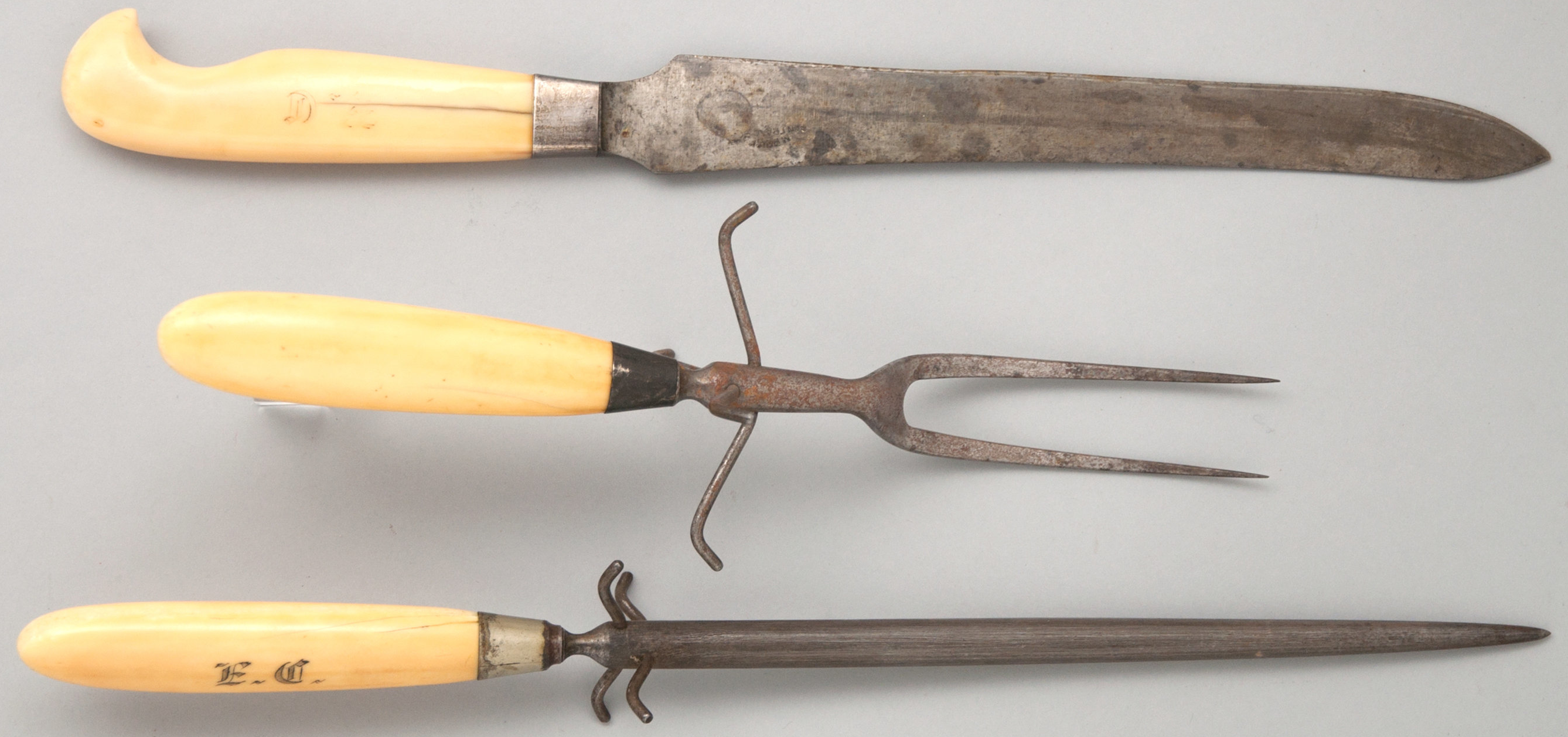
Michael Price carving set (unknown steel)
What Were the Best Knife Steels in the 1800s?
So before the 1870s the best knife steel choice was also the most popular, a simple high carbon steel made with the crucible method. Post-1870 the option of chromium steel was an interesting one, and probably would have been slightly superior to the simple carbon steels. That would offer a bit more wear resistance, better resistance to overheating in heat treatment, and also could be quenched more slowly and achieve full hardness. Mushet special steel was probably too extreme at the time, though it would be interesting to see an 1870s-era blade with that grade.
By the 1890s they would have technically also had access to F2 or CYW Choice, though I am not aware of any knifemakers actually using them. F2 has been used sporadically in knives over the years, offering a unique combination of being low hardenability (easier for forging or simple heat treating) along with relatively high wear resistance from the tungsten content. CYW Choice would also be very interesting, offering air hardening and wear resistance from its high chromium content. Chromium carbides are significantly harder than iron carbides. After all, the similar A2 makes an excellent knife steel, so CYW Choice could likely also work well.
Knife Steel in 1900-1939
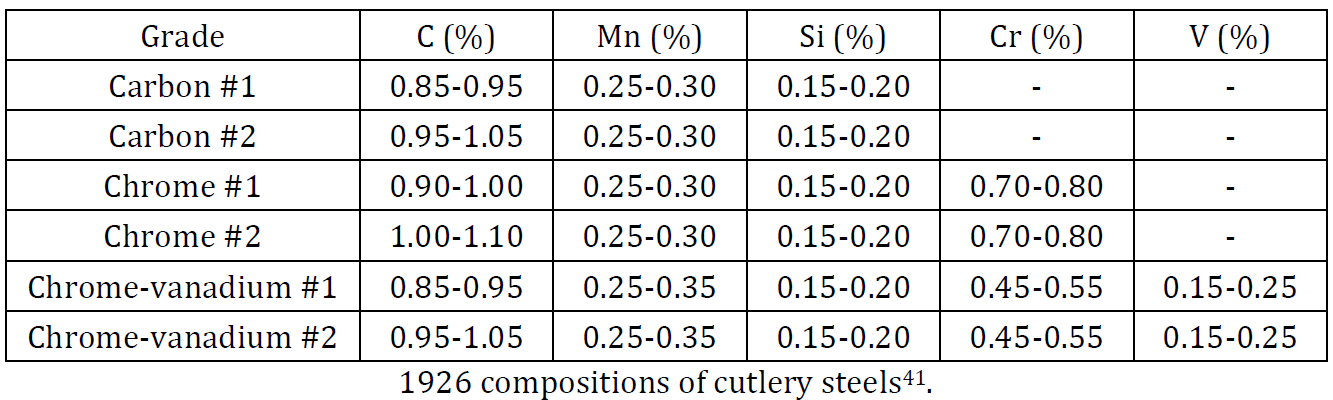
Despite the rise of many alloy steels, simple carbon steel like W1 continued to be the dominant choice for decades to come. There were some exceptions, however. Canton Cutlery began advertising vanadium-alloyed knife steel branded as “Car-Van Steel,” similar to W2. W.R. Case began purchasing “chrome vanadium” cutlery steel from Universal in December 1913 and Crucible Steel in 1915. I found a list of cutlery steel compositions from 1926 which included the simple carbon W1 types, 0.75% Cr alloyed types called “Chrome steel” and the 0.5% Cr, 0.2% V “chrome-vanadium” types. These 1926 compositions are very similar to steels used in more recent decades like 1095CV. The relatively common 80CrV2 is also similar to these grades but with 0.8% carbon.
The biggest alloy discovery in the early 1900s for knives was stainless steel, first developed by Harry Brearley in 1912. This early version was similar to the modern 420 stainless with about 0.3% C and 13% Cr. This steel was poorly regarded for its low hardness, and soon there were alternatives like 440A (1924), 440C (1925) and AEB (1925). Note this AEB is now called AEB-H, not the more common AEB-L; it had much higher carbon at 1% along with 14% Cr. Another important stainless was a steel called V3M in Germany (1922) which had higher carbon than 420 with 0.4% along with 14% Cr. This German steel would become the German specification called 1.4034, similar to the American 420HC.
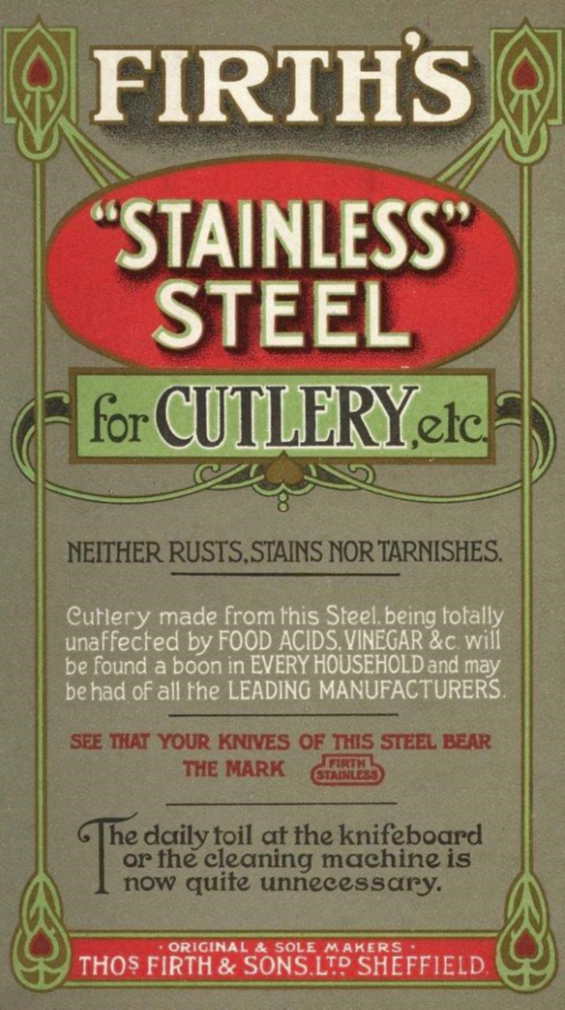
The pickup of stainless outside of “table cutlery” like carving knives and forks was very slow, however. First, World War I essentially put a halt to stainless steel until 1919. But after that, the cutlery companies didn’t like stainless because it was more challenging to forge, heat treat, grind, and polish. It required a wholesale change to the processing and many companies did not want to make modifications to their setup. It became common for people to claim that stainless steel had worse edge retention than carbon steels. By the 1930s, 90% of table cutlery was stainless but only 10% of pocket knives.
440A (as it was later called) became known as the “hard cutlery type” which was used for its superior hardness and wear resistance than 420. 440A was sold under various names such as Latrobe Hy-glo, Firth-Sterling “Stainless B,” or Crucible “Rezistal Grade B.” While I have found several references to these steels in the 1920s and 1930s, it was very rare back then to advertise specific steel types in knives. I tested a Schrade knife with a stamp from 1920s-1946 that had high enough chromium to be 440A. And a 1926 Schrade catalog implied they had recently switched to an improved stainless steel. A Remington 1937 sales manual also listed out information about their two stainless types, one a 420 and one a 440A/440B. I also tested a 1950-1964 W.R. Case knife that tested as 440, despite Case being best known for using 420HC in recent decades. I have also seen claims that Queen Cutlery was the first to use 440-type stainless steels but after investigating it I don’t think they were doing so until 1946.
One of the big advantages of using 440A or 440B vs the earlier 420 stainless was hardness. 420 was limited to the low 50s HRC while 440A could be heat treated as high as 59 HRC. And while 59 sounds relatively low today, the majority of carbon steel knives were around 56 HRC back then so the 440A was often being heat treated to a similar hardness.
Best Knife Steels in 1900-1939
While W1 continued to be the dominant choice, I would have preferred “chrome steel” or especially “chrome vanadium” steel for the slightly improved properties. 52100 was only really used in bearings, and O1 in tools in the early 1900s, but those would have been excellent choices as well. The high carbon, high chromium D3 tool steel has been used in small quantities in knives from the 1960s onward but it is too brittle for my taste. D2 has been a mainstay in the knife world, of course, but was not used in knives for several decades after its introduction in 1927. I don’t think high speed steels are the best choice for knives, but M2 after 1938 was a decent option. Gerber was famously using old hacksaw blades, which were first T1 steel and later M2, but that also wasn’t until 1938 at the earliest when David Z. Murphy began making knives.
For knifemakers preferring low alloy steels, my preference would be chrome steel in the very early 1900s, followed by 52100 after its introduction in 1905 if we are using revisionist history (the earliest record of 52100 in knives was the 1940s by Scagel during WWII steel shortages). After 1921 I would also like O7 tool steel for its wear resistance which is essentially chrome-vanadium steel plus 1.3% tungsten. For high alloy steels options CYW Choice would have been best starting in 1900, followed by D2 in 1927 and A2 in 1938, with an honorable mention for M2 after 1938 for high wear resistance.
Knife Steel in 1940-1989
Individual custom knifemakers were relatively rare in the early-to-mid 1900s, though there was an uptick during WWII. The most famous of these makers was Bo Randall who made his knives using O1 tool steel and 440B stainless.
Hoyt Buck of Buck Knives first started making knives out of used files (simple high carbon steel) after Pearl Harbor. This would evolve into a commercial factory knife company in the early 1960s where they used 440C because they were making too many knives to stick with old files. They switched to 425 Modified stainless steel in 1981 so that blanking was easier.
Gerber Knives would restart in 1945. They used old T1 hacksaw blades until 1948 because new hacksaw blades had a mild steel body with hardened steel teeth. At that point they would switch to M2 high speed steel supplied by Crucible Steel.
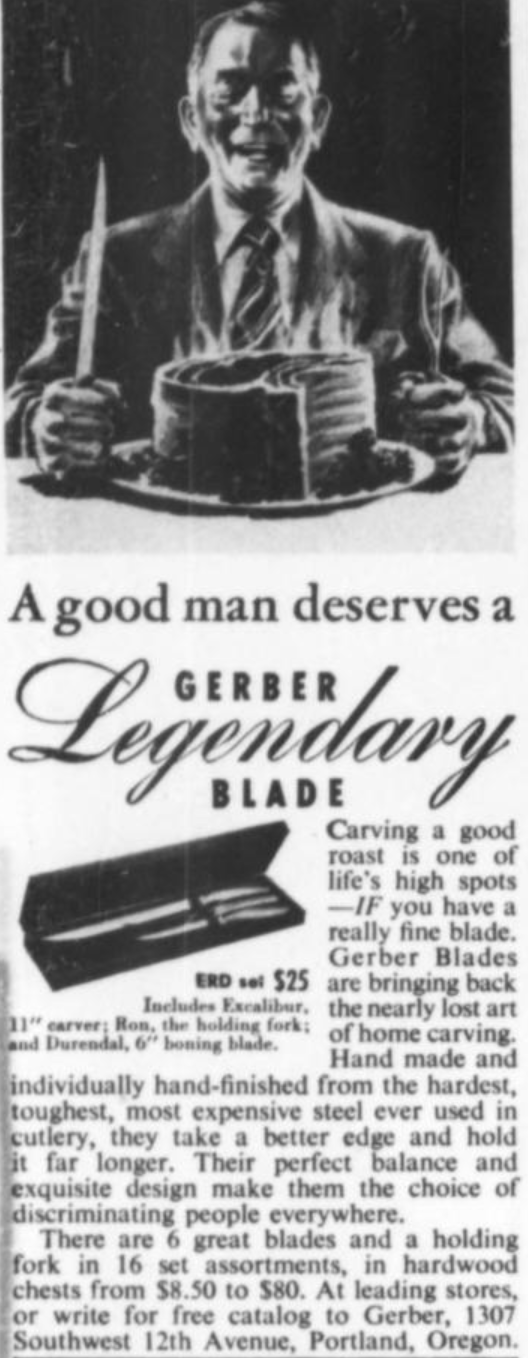
1950 Gerber ad
Gerber would expand into one of the largest and most respected commercial knife companies. They built a new factory in 1966. They added a new pocket knife called the Fh or Folding Hunter in 1968 in 440C stainless steel. This is the first commercial knife I know of that advertised a specific steel type:
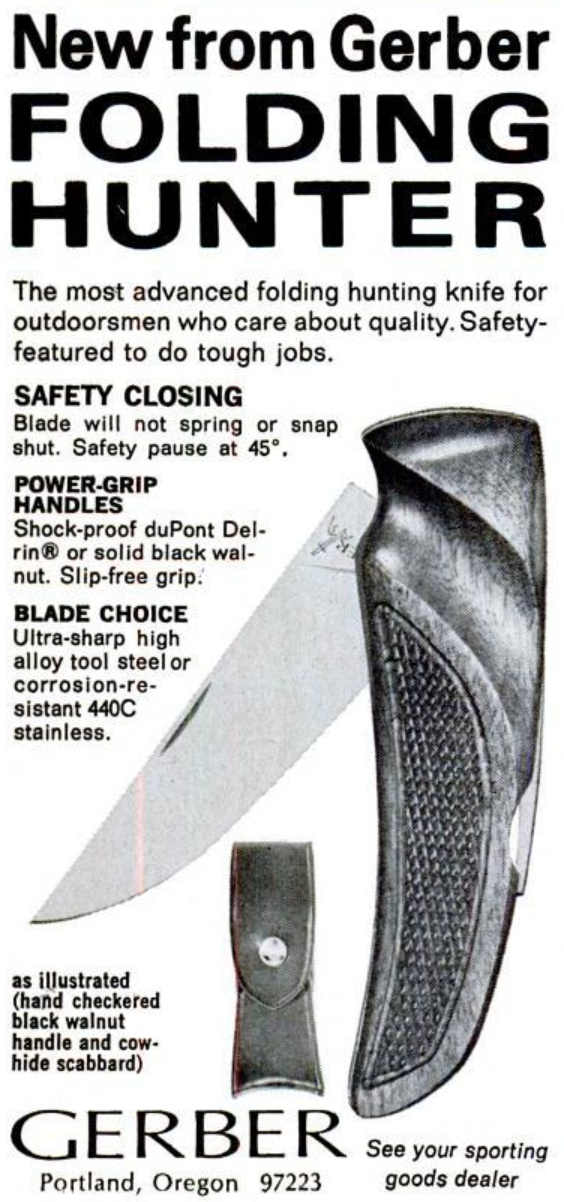
1968 Gerber ad
Rise of Custom Knives
In the 1960s and 1970s there was a big increase in the number of custom knifemakers. A.G. Russell brought those makers together leading to the formation of the Knifemakers Guild in 1970.
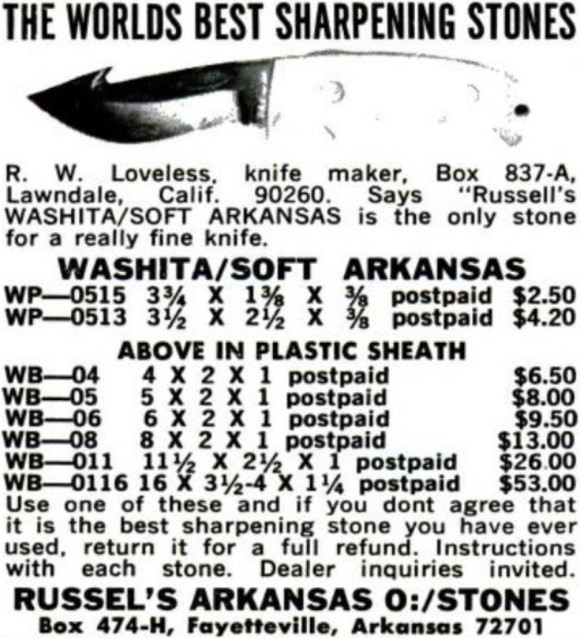
1970 A.G. Russell ad featuring Loveless knife
Most knifemakers were advertising the specific steel type they were using, even in this period. The most popular steels in 1973 were O1, A2, W2, D2, O6, 440C, and 154CM. By 1971 440C stainless was perceived as being the best stainless but still falling short of non-stainless steels. Early users of 440C included D.E. Henry in 1960 and Gil Hibben in 1963; both of them mentioned having to purchase round bar and forge it flat. D2 had a reputation for having better properties than 440C but was not truly stainless. Early users of D2 in knives included Jimmy Lile and Chubby Hueske, who both started using it around 1968. In the fall of 1971 Loveless started using the bearing stainless steel 154CM and this grade became very popular.
From a different perspective of makers like Loveless using “new” fancy steels like 154CM were the forging smiths like Bill Moran who advertised the use of simple steels that were forged. Moran promoted that the forged blade was superior and that stainless steels did not benefit from the process. Moran’s focus on the past and recreating legendary blades led to his reintroduction of pattern-welded Damascus steel to the market in 1973, which were advertised as having superior properties in addition to the beautiful patterns. Damascus steel inspired many more makers to take up forging, leading to the formation of the American Bladesmith Society in 1976. I wrote more about the different philosophy of new steels with stock removal vs carbon steels with forging in this article.
Bob Schrimsher was the earliest to start a dedicated knife supply company in 1969. Before that A.G. Russell was supplying steel and handle materials. The steels that knifemakers use has historically been closely tied to what is available from knife supply companies. Especially back then it was not feasible for a knifemaker to call a steel company and order because they couldn’t purchase the minimum required amounts.
Custom Knives Inspiring Factory Companies
The growing custom knife market had more and more influence on factory knives. This led to Schrade working with Bob Loveless on what would become the first “factory collaboration” knife released in 1975. This was also the first factory knife to feature 154CM steel.
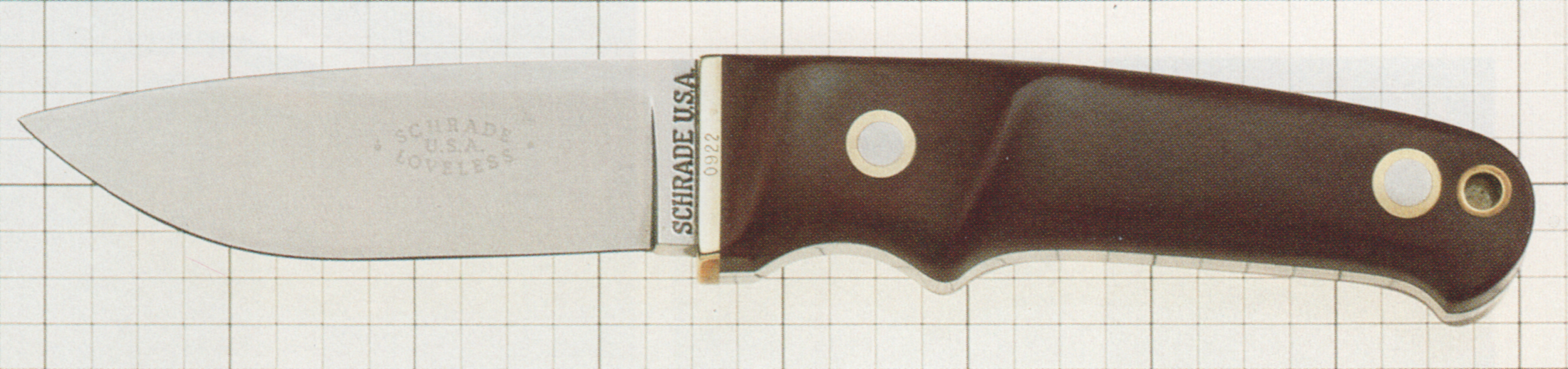
Ted Dowell would popularize Vasco Wear steel in knives after he learned about the steel from Bernard Sparks. Dowell began advertising the steel in 1977. This would influence Gerber, which would also use Vasco Wear in the FS II knives from 1982-1988.
Rise of Japan
Japanese factory knives gained more and more influence over the market starting in the 1970s. Pete Kershaw, a Gerber salesman, left to form his own company in 1974. These knives were marketed in 1976 as “Kai stainless” and in 1978 as “high carbon Kai stainless steel blade from the AUS series is an improvement over famous 440-C.” These were the grades AUS-6 and AUS-8A made in Japan.
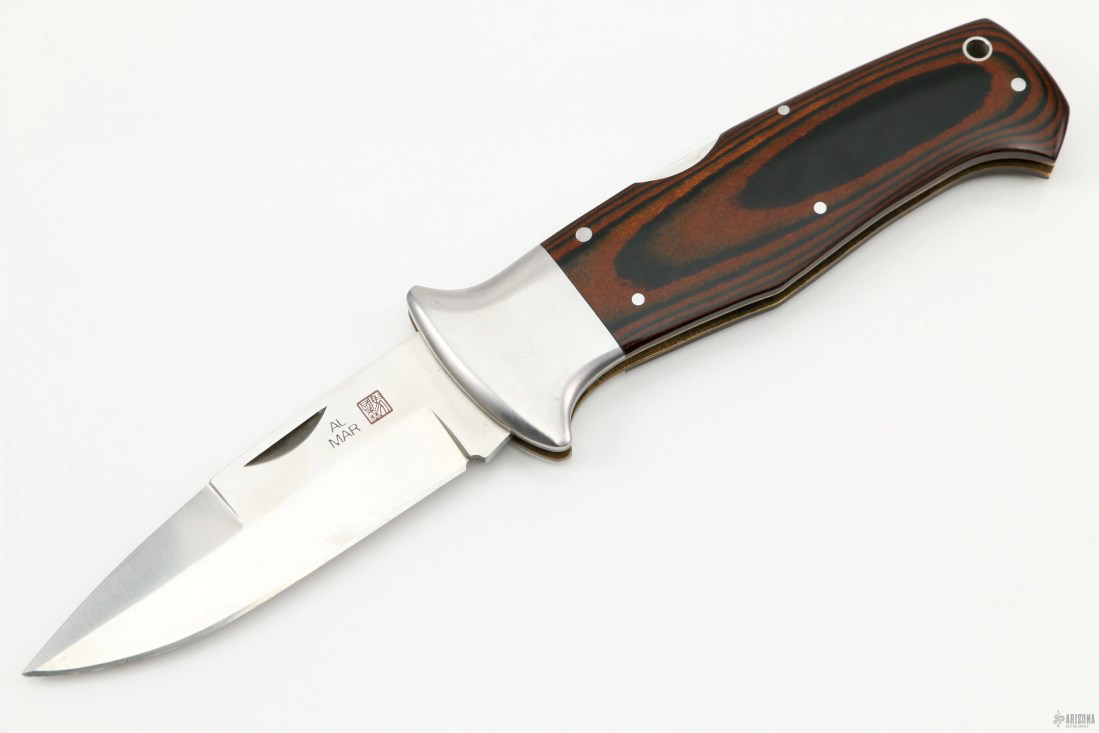
1980s Al Mar SERE. Photo from Arizona Custom Knives.
154CM began to develop a reputation for being “dirty” with a high impurity content. Knife deal Okayasu Kazuo spoke to Hitachi and learned that they already made a version of 154CM called ATS-34. This steel was both cheaper and cleaner than 154CM and became the dominant custom knife steel in the 1980s and 1990s. The first factory knives available in the steel came from Al Mar knives produced in Japan in 1984.
Best Knife Steels 1940-1989
Factory knives largely continued to use 420, 440A, and simple carbon steel through the 1940s and 1960s. Some companies like Gerber and Buck began using 440C in the 1960s. And factory knives expanded into AUS-6/AUS-8A and ATS-34 after that.
Custom makers started with low alloy steels like O1 and W2 or high alloy steels like D2 and 440C. But 154CM and pattern-welded Damascus were the big turning points for what became popular in the early 1970s. There were also some intriguing less common options like Vasco Wear, however.
But in terms of what would have been truly best if it had been known and available is also an interesting question. 12C27 and AEB-L came out in the 1960s and those would have been good alternatives for high toughness. It wasn’t until the 2010s that AEB-L really began to take off in the custom knife world. BG42 also came out early, in 1961, and didn’t gain much popularity until the late 1990s, though I’m not sure it is a pure upgrade over 154CM.
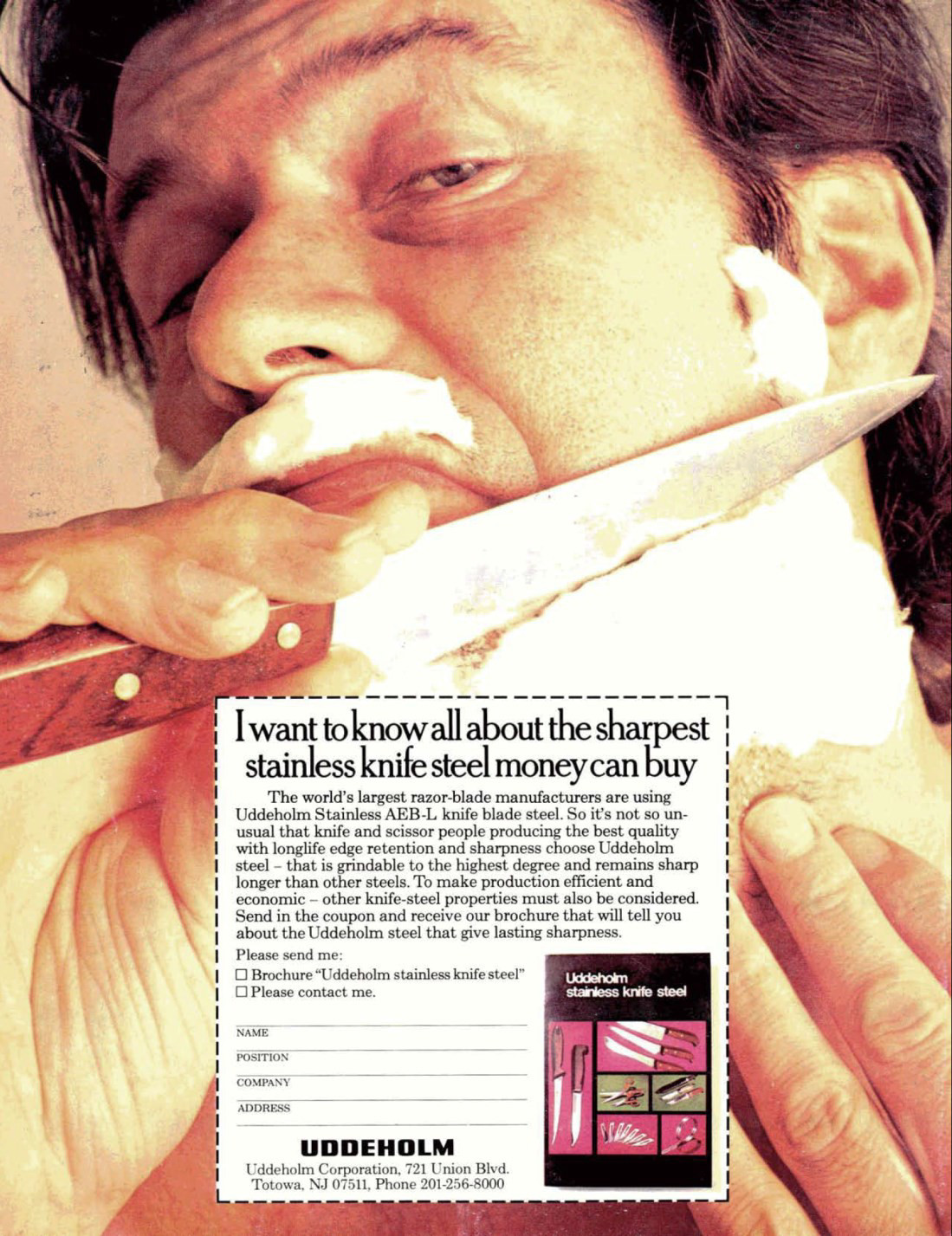
1981 Blade Magazine ad for Uddeholm AEB-L
Other interesting choices would have been CPM-M4, released in 1973. Tim Wright first used it in 1980 but it didn’t become popular until the mid-2000s. That would have had superior properties to many of the conventional alloys being used in the 1970s and 1980s. And CPM-10V released in 1978 would have had higher wear resistance than any other steel on the market while still maintaining good toughness. The earliest case of its use I found was Ralph Turnbull in the early 1980s. Abrasives were not very good then and Turnbull reported that getting a good finish was nearly impossible.
Near the end of our 1940-1989 range there was the stainless CPM-440V (S60V). It was an interesting choice that didn’t gain any real popularity until the mid-to-late 1990s, which we will discuss in the next sections.
Knives and Steel in 1990-2001
In terms of steel developments there were a few interesting ones that largely didn’t get used in this decade. These included Elmax released in 1990, and M390 released in 1992. M390 in particular gained popularity much later, but initially was not pushed by Bohler as a knife steel. Later in the decade there was CPM-420V (later S90V) released around 1997, and CPM-3V released around 1999. In 2000 Crucible would change the name of CPM-440V to CPM-S60V and CPM-420V to CPM-S90V.
In terms of knives this was one of the oddest decades for knife steel, at least to me. ATS-34 continued to be the most popular choice into the 90s; if you include 154CM this was quite a long period of dominance for the steel. Despite BG42 being nearly as old as 154CM, it didn’t start to gain much popularity in knives until the mid-90s. Chris Reeve, inspired by Ted Dowell’s use of BG42, had called Latrobe Special Steel and convinced them to roll it into the right size for his knives which led to the wider availability. Factories like Buck and SOG offered it in knives shortly afterward. Knife supply companies like Tru-Grit were offering it in 1998, which also increased its popularity among custom knifemakers.
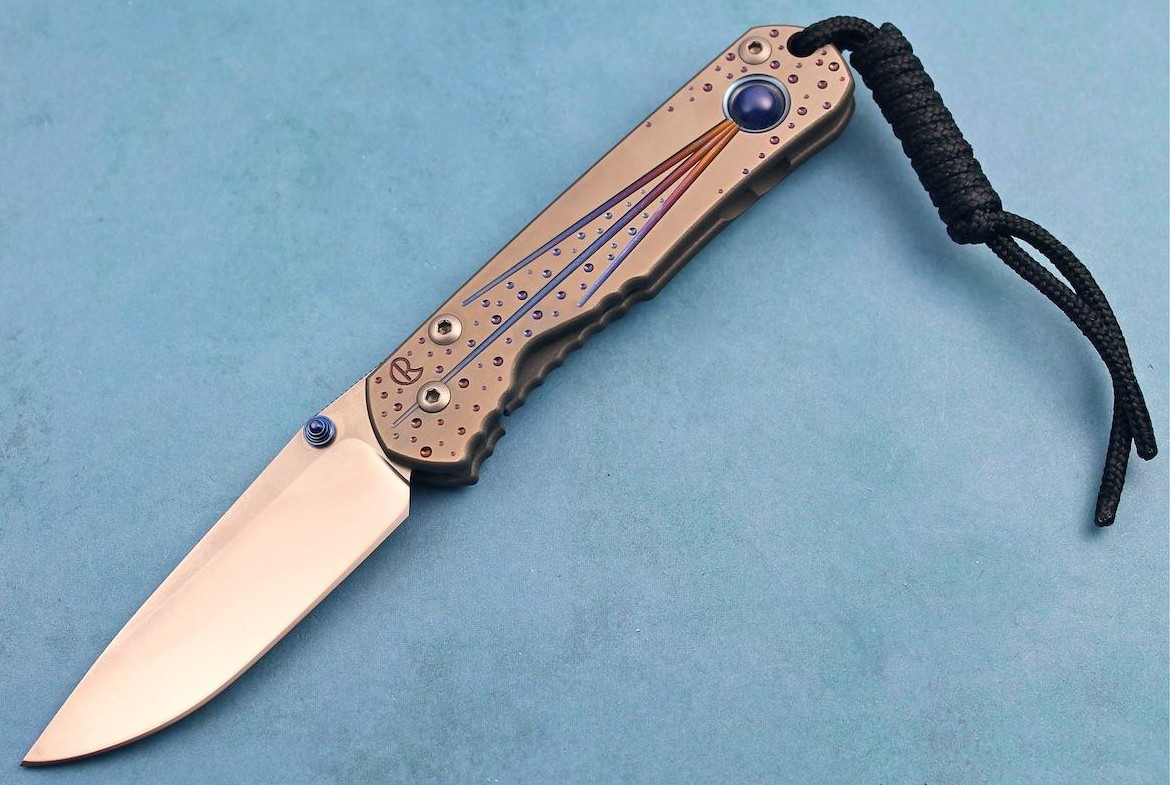
Chris Reeve small Sebenza in BG42. Photo by KnifeTreasures.com
Another alternative to the increasing price and decreasing availability of ATS-34 was to go back to the original – 154CM. Crucible Steel began making it in thin sheet again, providing a source for USA-made steel.
Spyderco introduced VG-10 into its Japanese-made knives starting in 1997. Ironically the first knife to use this steel was a fixed blade designed by Bill Moran, a knifemaker who famously did not like stainless steel. VG-10 would become a mainstay with Spyderco knives for years to come.
In the mid-90s Crucible’s CPM-440V (S60V) became more commonly available and its popularity steadily, though slowly, increased. The primary complaints about this steel were the difficulty in finishing, with the secondary complaint being toughness. Abrasives available to knifemakers and knife companies were not well suited to the high vanadium content of the grade. The recommended heat treatments were also poor, in my opinion, generally resulting in about 56-57 HRC.
Custom knifemaker Phil Wilson wrote many articles about knife steels in the mid-90s through the 2000s and he reported obtaining some CPM-420V around 1997. He said that the steel was even more difficult to finish than 440V but would cut longer, had higher toughness, and was easier to heat treat to higher hardness. Microtech would add it as an upcharge option starting in 2000.
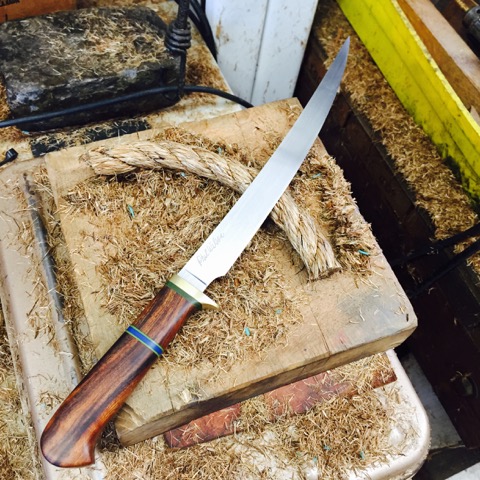
Phil Wilson fillet knife
Best Knife Steels in 1990-2001
Two steels I think could have done well in this time period were Elmax and M390, released early on in the 1990s but didn’t get much use in knives until much later. They have a much lower content of hard vanadium carbides so the knife companies wouldn’t have had as many issues finishing them with the abrasives which were then available. Those steels would have also had superior toughness and edge retention to BG42.
I do like the steels CPM-440V and CPM-420V, S60V and S90V, however. It seems, like Marty McFly once said, that they weren’t “ready for that yet.” S90V has similar toughness to Elmax and M390 but with significantly greater wear resistance. But that greater wear resistance was also one of its biggest barriers to being used more frequently.
CPM-3V also has excellent toughness with good wear resistance, but it didn’t catch on widely at that time, perhaps because it is non-stainless.
Knives and Steel in 2002-2019
A huge moment in knife steel was the release of CPM-S30V in 2002. This was the culmination of Crucible Steel’s continued interest in the knife market. Dick Barber and Ed Severson of Crucible would go to Chris Reeve and ask him what they could do to get him to move from BG42 to their steel. He told them that S60V and S90V had too much vanadium for him to easily work with them, but he would switch if they could give him an improvement over BG42 that he could machine and grind. The new steel was advertised as being designed “specifically for knives” and took off basically immediately.
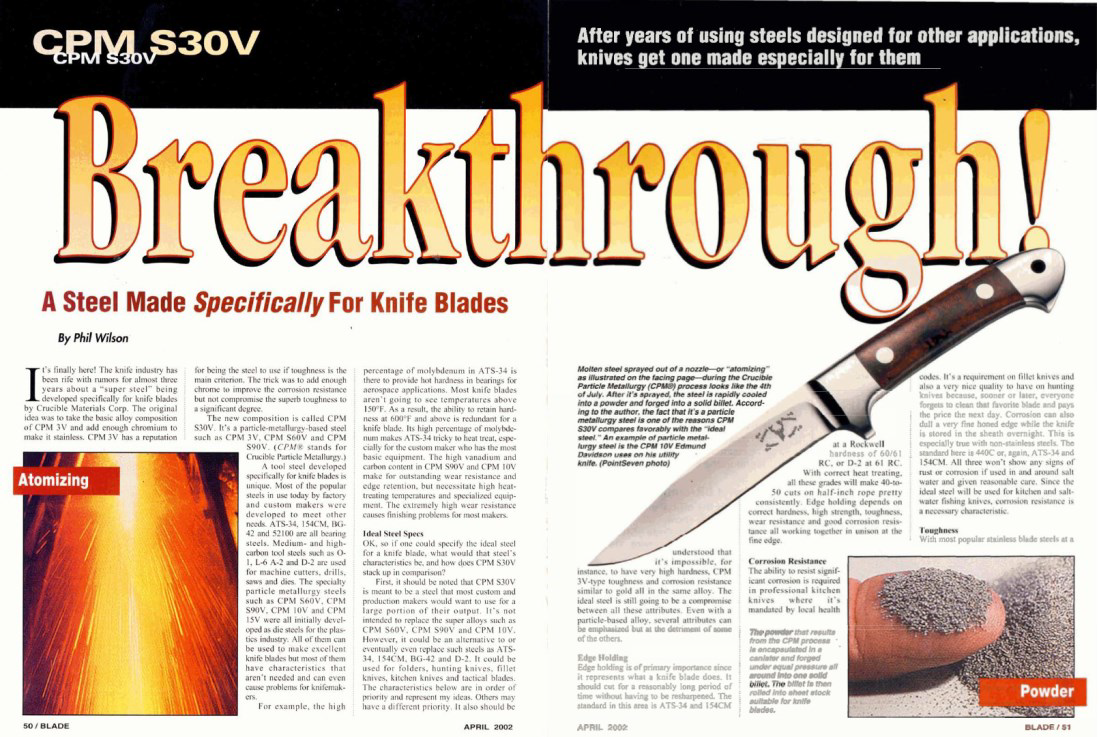
2002 article on S30V by Phil Wilson
After S30V, the other 90s “alternative” grades like BG42, S60V, and S90V basically went away in the knife world. Almost every knife company switched to the new steel. By 2003, S30V was the top selling knife steel from Crucible.
CPM-M4 would also build in popularity in this time period, especially in competition chopping knives for the new Blade Sports competitions. It would develop a reputation for having an excellent combination of properties including both toughness and wear resistance, though was not stainless.
Chris Reeve would request a new steel with improved machinability over S30V which led to the release of CPM-S35VN by Crucible around 2009. This would take over from S30V with a lot of knife companies after that. S35VN also had significantly higher toughness than S30V though at the cost of a little wear resistance.
Bohler-Uddeholm began pushing their steels in the USA, including N690, M390 and Elmax. They also pushed their version of D2, Vanadis 4 Extra, Vanax, K294, and K390, though with less success. K390 would become more popular a bit later after Spyderco began using it. M390 would be the main winner out of this group in terms of popularity, serving as an alternative to S30V and S35VN.

2011 Blade Magazine ad for Uddeholm Vanax
Kershaw would start using Sandvik’s 13C26 steel in their blanked knives made in their USA factory. They were unhappy with the corrosion resistance which led to Sandvik developing the improved 14C28N in 2009.
There were powder metallurgy versions of Vasco Wear coming out in this period, including Carpenter’s PD#1 in 2001, Zapp Z-Wear in 2010, and CPM-CruWear in 2013.
Spyderco would also introduce Zapp LC200N into their knives in 2013. This steel dates back to 1993 under the initial name of Cronidur 30.
Best Steels in 2002-2019
S30V, S35VN, and M390 were the big winners in this time period. In hindsight I don’t think S30V was really an improvement over the earlier Elmax and M390, but those steels were not generally available in sheet for knives. S35VN has better toughness than S30V, Elmax, or M390 which gives it more of a niche that is relevant.
For a non-PM less expensive stainless steel I think that 14C28N was a meaningful improvement over 13C26 and AEB-L, having higher corrosion resistance with otherwise similar properties.
Vanadis 4 Extra was a well balanced PM non-stainless steel introduced around 2004 but it didn’t really take off. The more available CPM-M4 offered similar properties, with somewhat better wear resistance and somewhat worse toughness.
Conclusions and Summary
For the table below I didn’t include any steel for a particular decade unless it came out early in the decade. In other words, if it came out in 1993 or before, it counts for that decade, but 1994 would not. This is not a comprehensive chart for everything so there is plenty left out but gives a summary of some of my thoughts above. Normally, I would want a full range of recommendations based on cost, manufacturing method, and the toughness-wear-resistance balance.
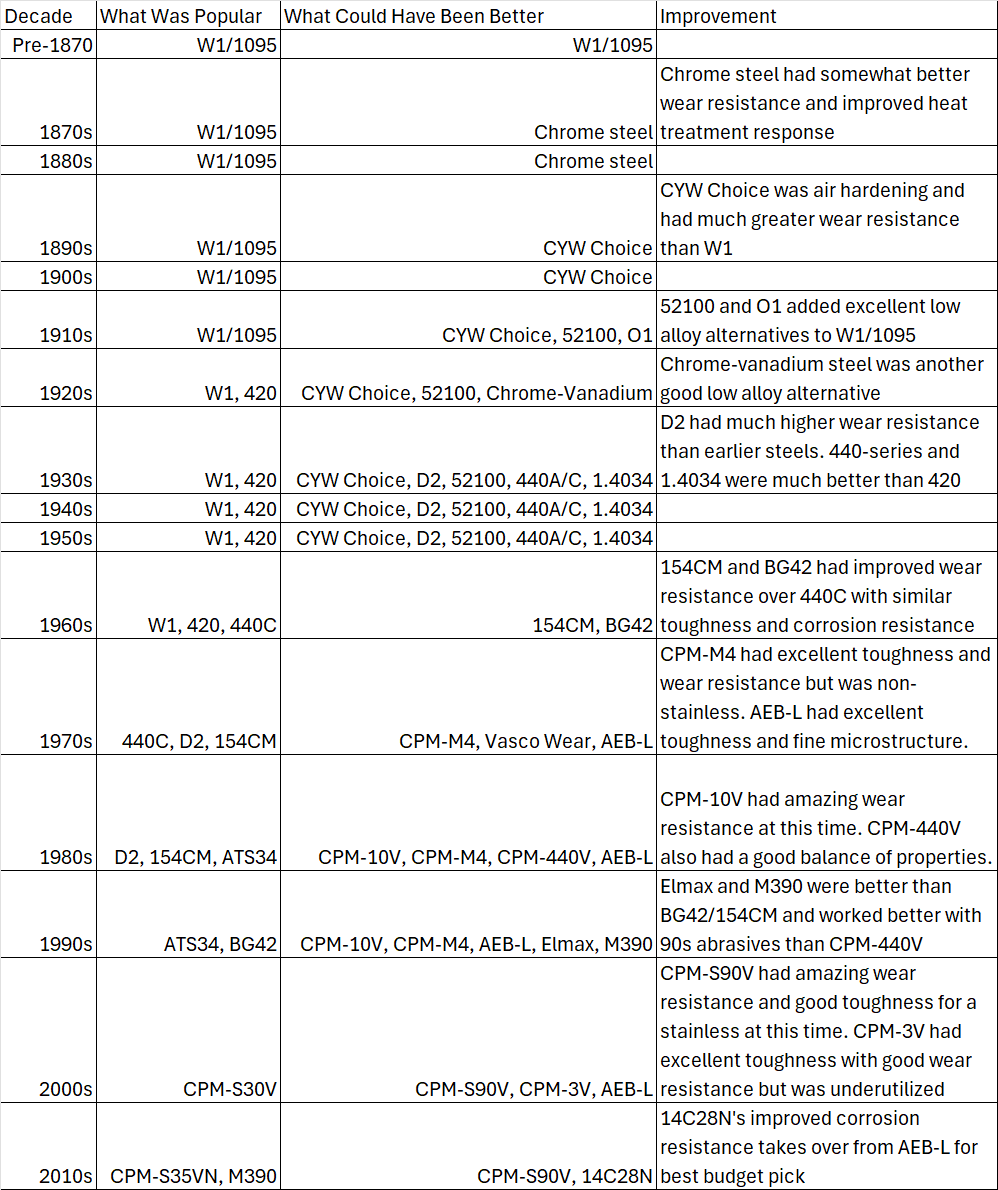
So I hope you have seen how messy the history can be, with large gaps between a new steel being released and it actually seeing use in knives. And there were many periods when better steels were available than what was being used. It is fun to look at hypothetical scenarios where CYW Choice would be used in knives starting in the 1890s, or CPM-M4 would have been popular with the new growing custom knife market of the 1970s, or if M390 and Elmax were popular throughout the 1990s.
