
If you would like to join the Knife Steel Nerds Patreon to support knife research visit Patreon.com/KnifeSteelNerds You can read articles and watch videos early, and at the top level you even get a mug!
I have two classes for “Blade University” at Blade Show Atlanta coming up the beginning of June. They are titled “Factors that Affect Edge Retention” and “What is Coming Next for Knife Steel?” Read more and buy tickets here: https://bladeshow.com/show-info/classes/
YouTube Video
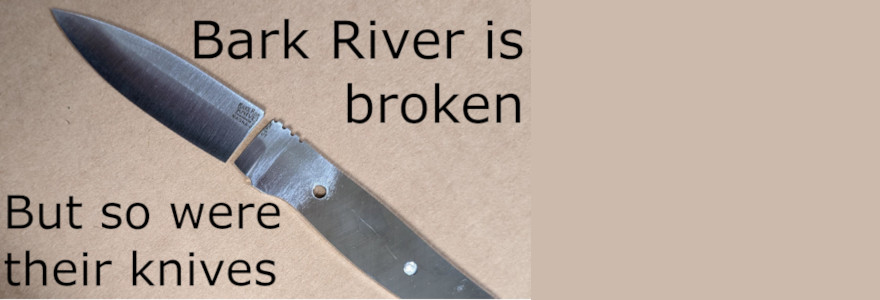
Bark River Closing Down
American company Bark River Knives is shutting down. There is a pretty good write-up of the situation in this Outdoor Life article. One thing the article doesn’t discuss is the large number of people coming out now who say that Bark River or Mike Stewart owes them money for past services or products. Since the company is going away, I thought this was a good opportunity to discuss the mistakes it made in design and manufacturing that others can learn from. This includes other knife manufacturers and custom knifemakers. And for knife buyers, you can look for signs that indicate issues with a knife before purchasing it.
Mislabeling of Steel
One of the biggest controversies of the Bark River situation is the owner, Mike Stewart, admitting that they were purchasing China-produced blanks, reworking them, and stamping CPM-154 and “Made in USA” on them. He also defended this practice saying in their testing the steel was almost as good as CPM-154 and that since they performed “5 operations” on each knife that counted as Made in USA. Testing a steel and saying it is “almost the same” does not mean you can mislabel it. I think that much is basic. You can’t buy a car manufactured in China and decide it works just as well as a Dodge Charger and slap the logo on it. This would be illegal for infringing a trademark, both for the Dodge Charger and for the CPM-154. Also, Mike Stewart seems to have a very poor understanding of what “Made in USA” entails. Even if he had started with raw barstock from China and manufactured the knife from start to finish it would still not be legal to mark it as “Made in USA.” He would have to have a qualified label like “Made in USA from imported materials” or something along those lines. But even that label would of course not qualify when starting with a finished knife blank from China. But as a steel metallurgist, the most upsetting part to me is the misrepresentation of what the steel is. It’s obvious they just don’t care what the steel is as long as they can justify putting a label on it they think would sell better.
Broken Bark River Scout Knife
In 2022 there was a video from Dutch Bushcraft Knives (DBK) where they tested a knife in MagnaCut from Bark River Scout and it broke at the jimping while they were batoning (autocorrect does not like either of those words).
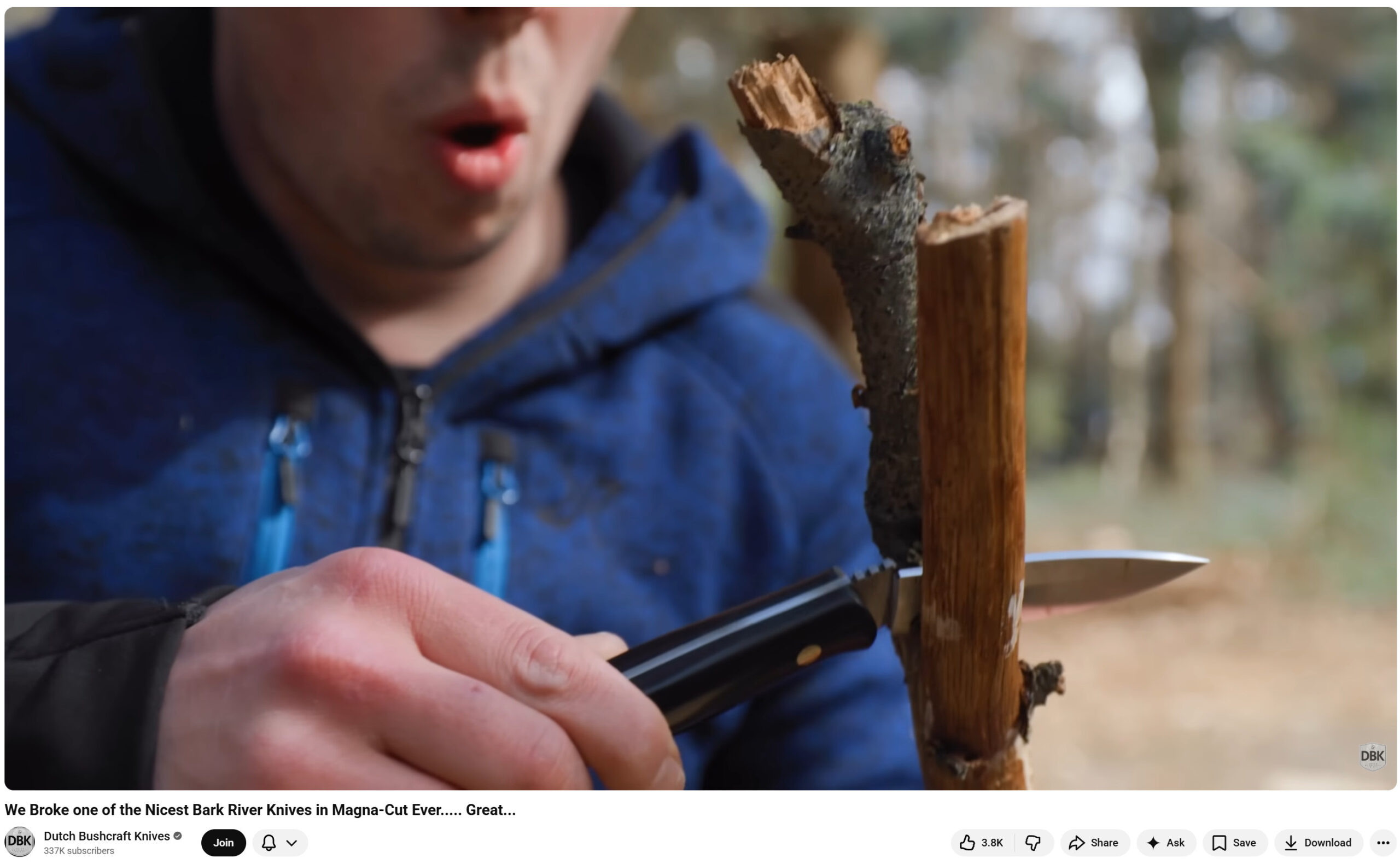
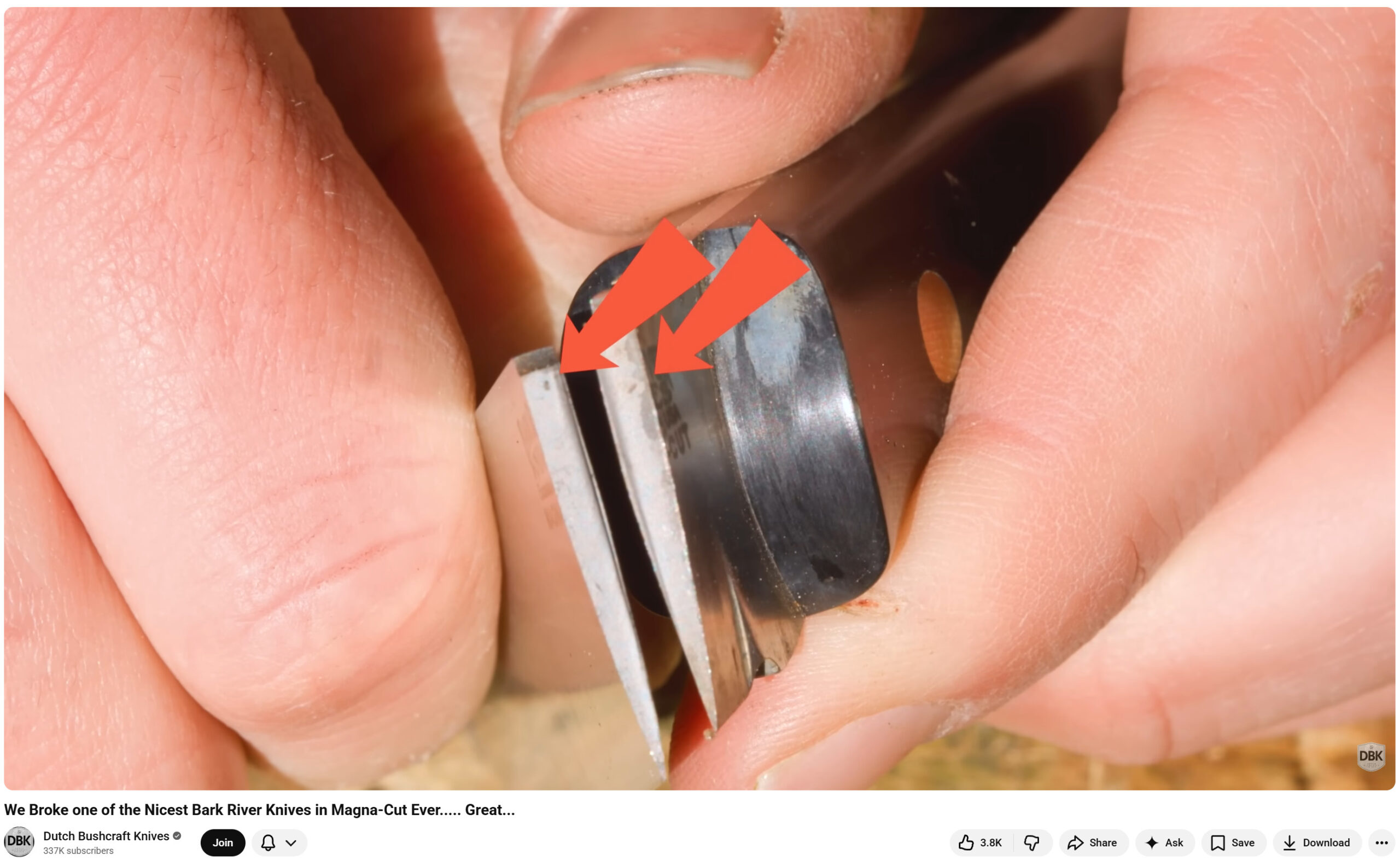
They talked to Bark River and were told the fault was with the steel and they pointed out some discoloration in the fracture surface, claiming this indicated an inclusion in the steel. An inclusion is a non-metallic compound in steel like an oxide or sulfide. Inclusions are present in every piece of steel, the question is about how many and how big. Inclusions that are so large you can see them with the naked eye are rare, and the discoloration they pointed out in the video does not look consistent with an inclusion.
Another Broken Bark River Scout
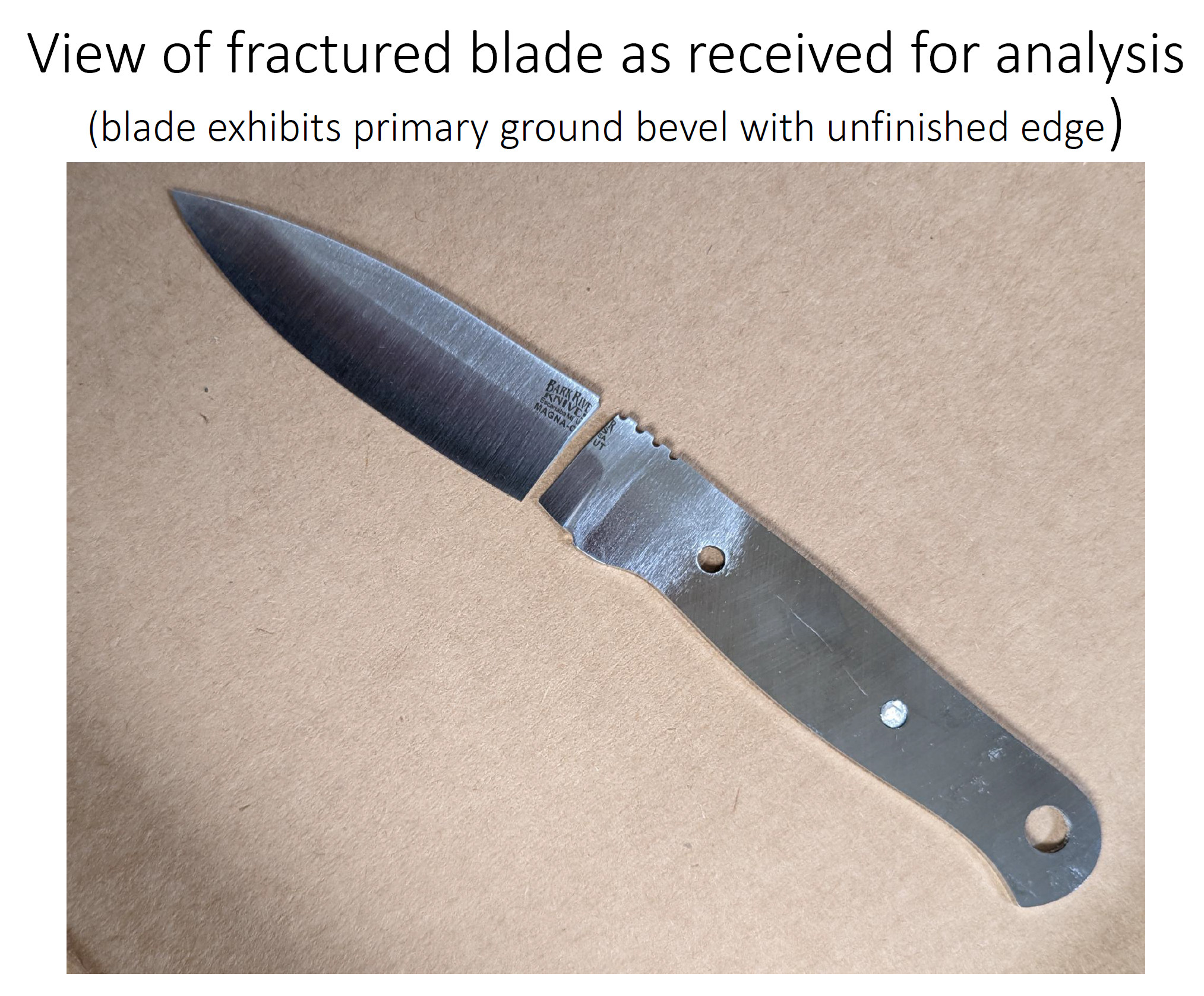
Bark River broke a knife of the same model in MagnaCut during manufacturing and sent it to Niagara Specialty Metals requesting an investigation into the steel. Bob Shabala of Niagara sent the blade to an independent third-party metallurgist named Gary Maddock. He evaluated the broken blade and sent a report to Niagara and Bark River.
Stress Concentrations
So this is a completely different knife of the same model that broke in the same exact place. And not even from using the knife but just while manufacturing it. So we must start discussing what a “stress concentration” is (also called a “stress riser”). I wrote a whole article about stress concentrations back in 2019. As the name implies, a stress concentration is any region of a part where the stress is concentrated. One simple way of concentrating stress is by having a reduced area in a portion of a part. As a metallurgist we often perform “tensile tests” where the standard is to have a reduced cross-section in the region to be tested. This ensures (almost 100%) that the fracture will occur in that reduced area:
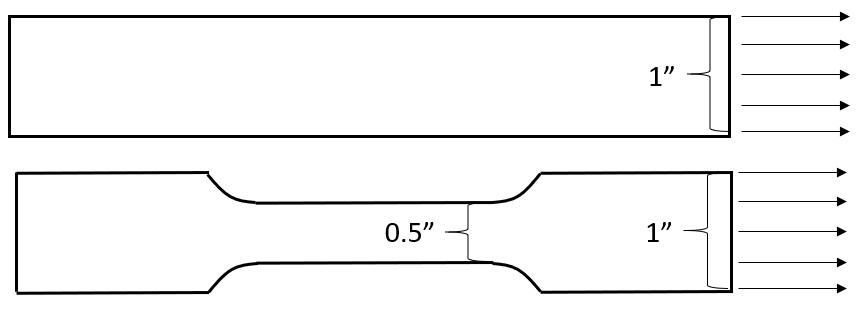
Stress is just load divided by area, so if the width in that region is half of the rest of the flat piece, the stress would be twice as much in that region. However, stress concentrations can be much more extreme than this. The most common example of a bad stress riser is a sharp corner. This leads to very high stress in a small region of a part, such as is shown in this simulation:
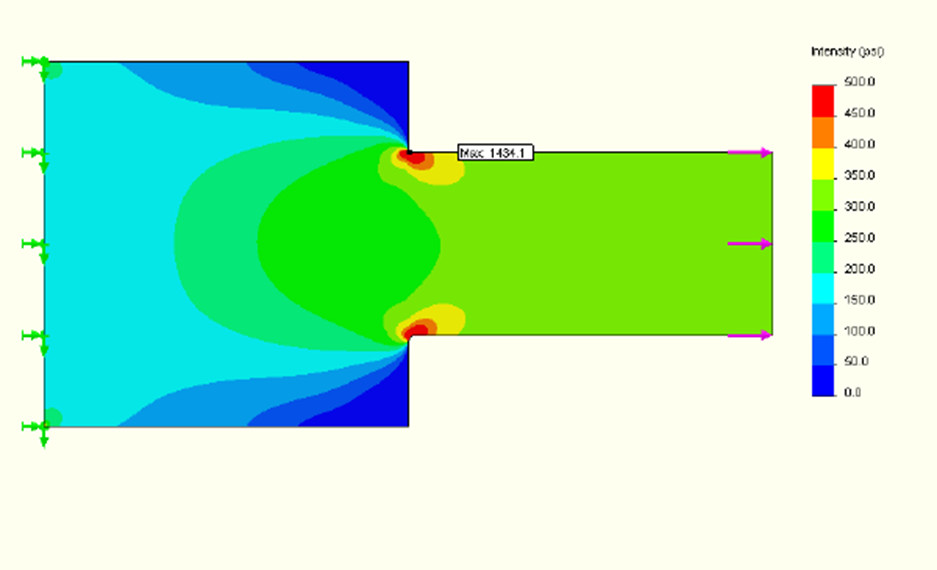
The red region shows a much higher stress than the rest of the part being pulled apart. So we can predict with some high level of certainty that this part would break right at those sharp corners. This is all relevant, of course, because the jimping on that knife led to a stress concentration when the knife is being flexed.
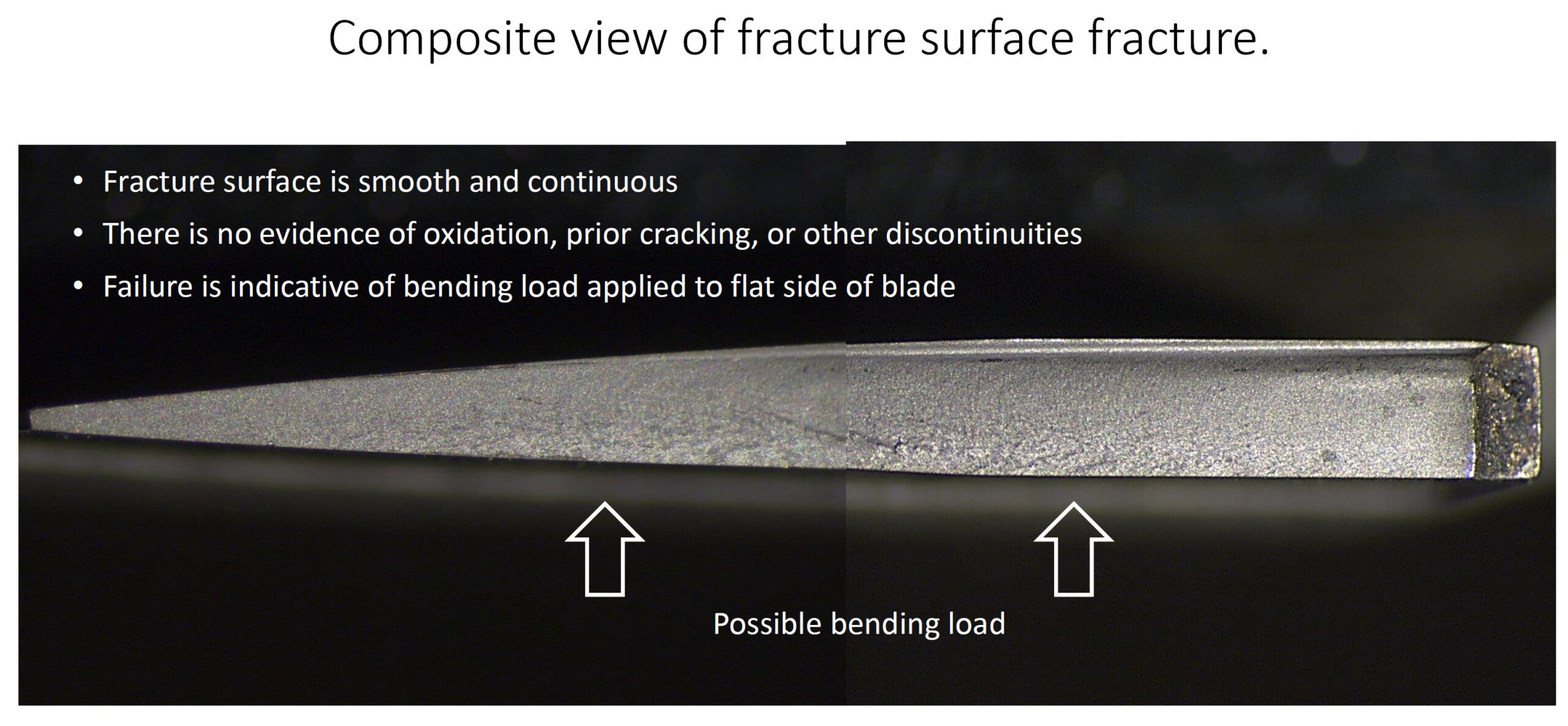
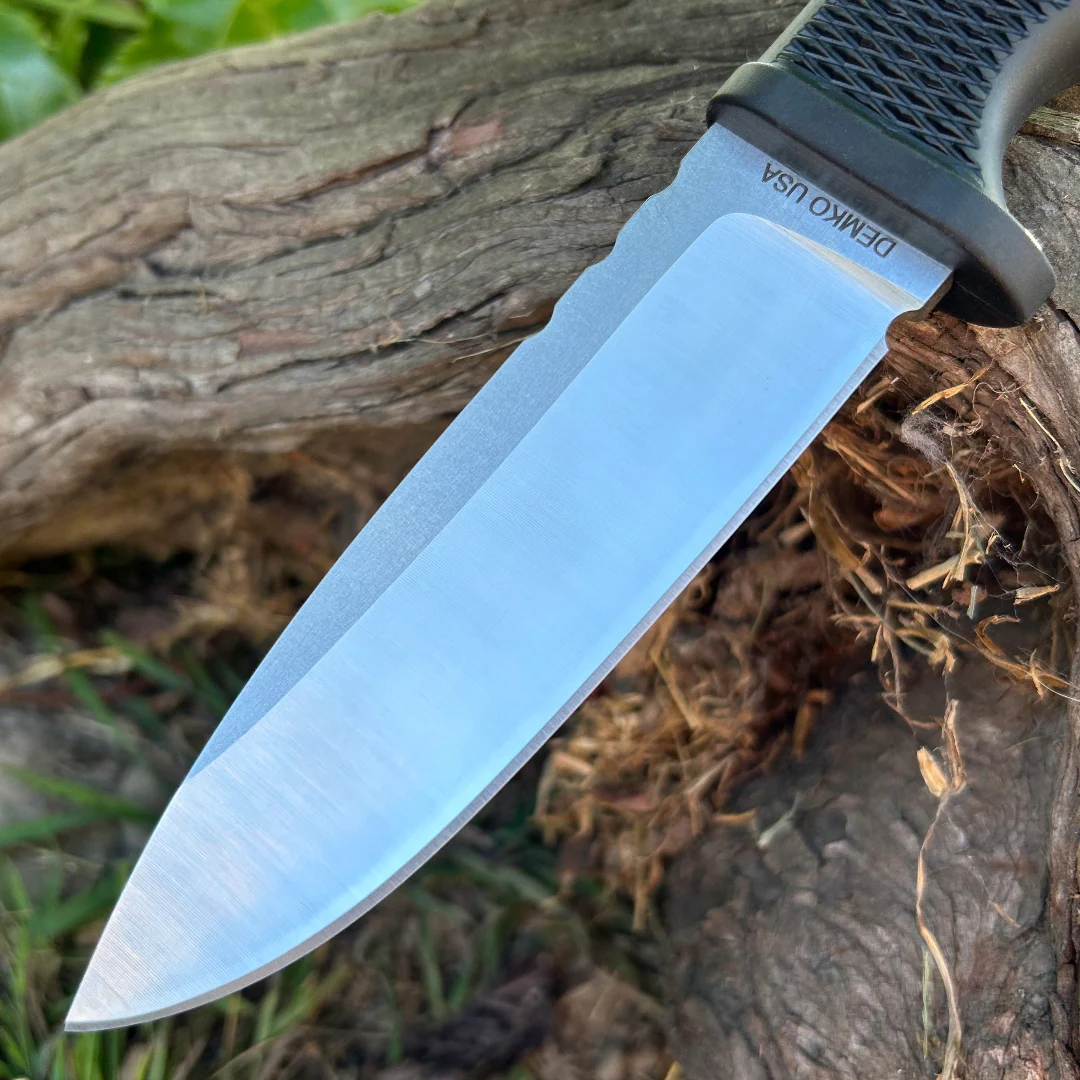
So how could Bark River have avoided the stress concentration of the jimping? One method is to remove the jimping altogether, of course. There has been debate in the knife community for decades as to whether jimping is beneficial. Another way would be to round out the design of the jimping to reduce the stress concentration. Making it shallower and more rounded would be beneficial. An example would be this FreeReign knife from Demko:
Surface Roughness
Another important factor in this knife breaking is that the method used to cut the blank led to a very rough surface, and that surface was not cleaned up within the jimping.
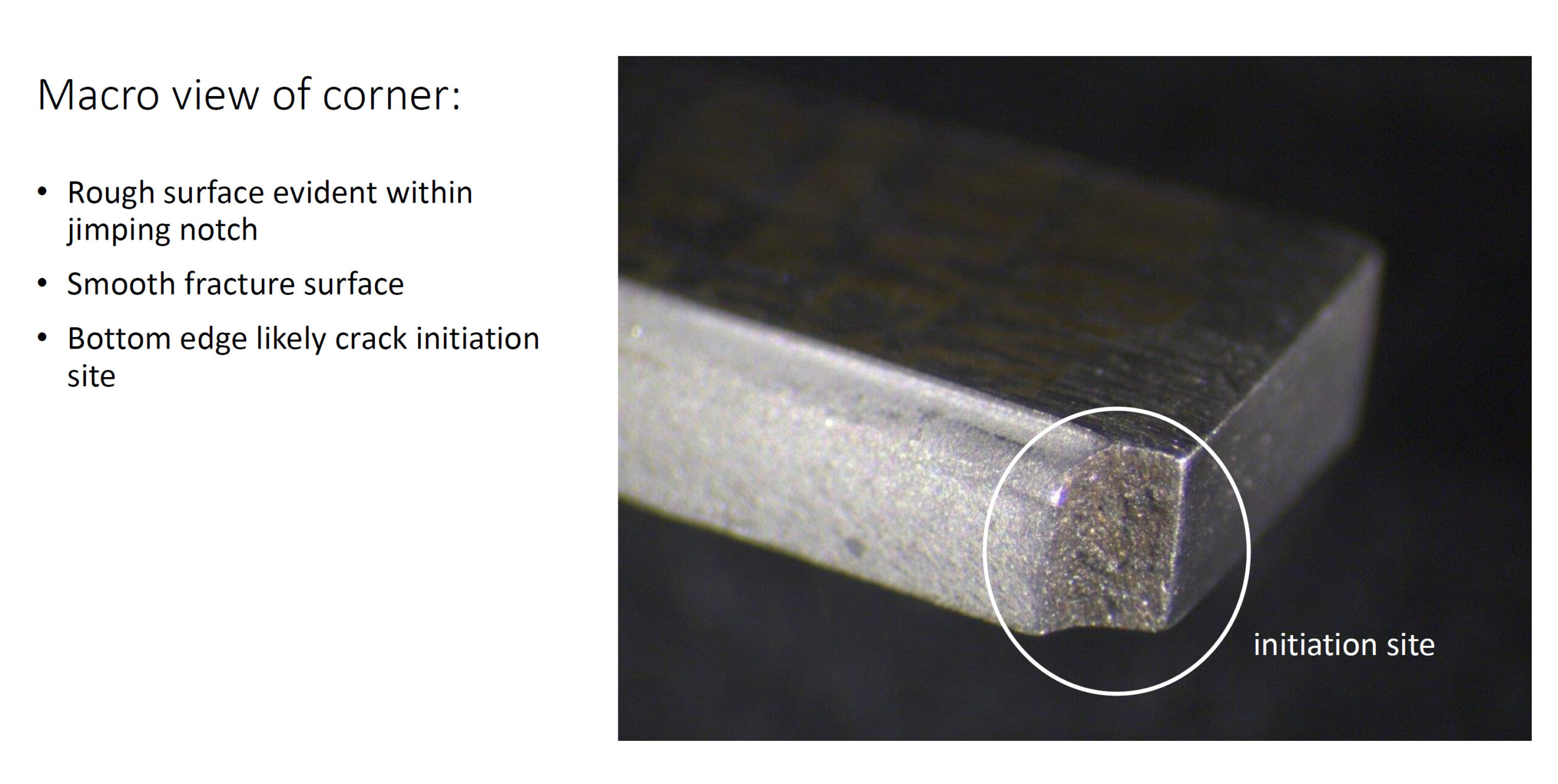
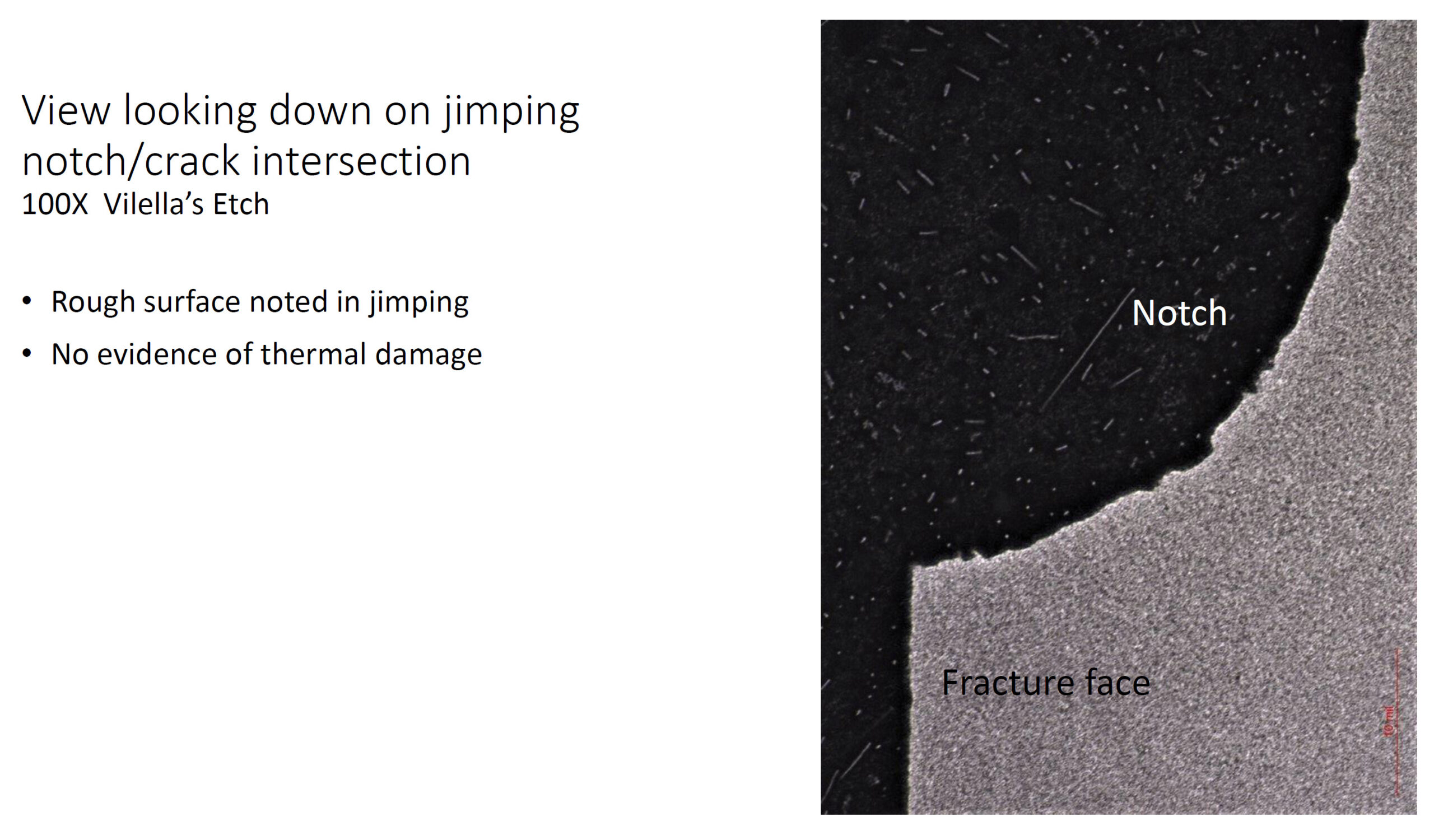
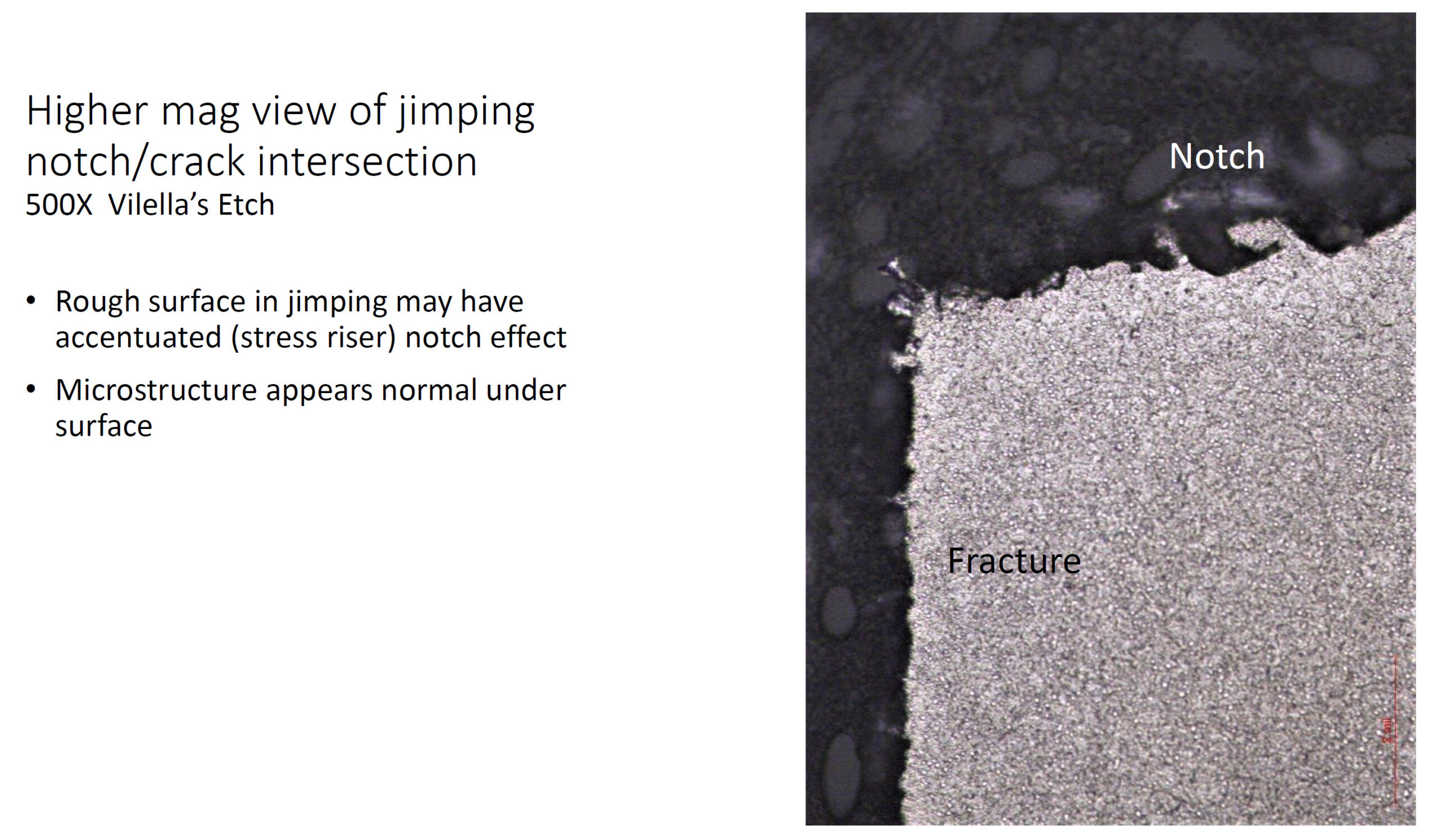
So Gary Maddock noted that the rough surface in that jimping may have accentuated the stress riser. The rough surface has many discontinuities in it; basically areas that already look like a crack. It makes crack initiation easier because a crack is already half formed. The other thing he noted is that there was “No evidence of thermal damage” and “Microstructure appears normal under the surface.” He noted this because laser cutting can lead to a “heat affect zone” (HAZ) where the microstructure can be different than the rest of the steel. Laser cutting essentially means the steel is being locally melted, so when steel has been melted and resolidified this leads to a cast structure which is likely to be more brittle than the rest. Even away from the melted region the steel can be rehardened and thus be harder and more brittle than the bulk steel. So for both the possibility of HAZ with laser cutting and for high surface roughness with laser or waterjet it is best to refinish the perimeter of blades after they are cut out.
Bark River MagnaCut Corrosion Resistance
Some Bark River Knives were reported to easily stain or rust in MagnaCut. Mike Stewart claimed that was because MagnaCut is not a stainless steel. He claimed “i would never have listed this as a True Stainless – Crucible does but I disagree with them.”

It is silly that he was claiming to have knowledge of what classifies a steel as stainless better than the steel manufacturer itself. The most basic definition of what a stainless steel is is that it has at least 10.5% Cr, which MagnaCut has. However, this definition is overly simplistic, as there are some steels like D2 tool steel which are famously not stainless despite having enough chromium to meet that definition. The high carbon (and lack of most other elements) in D2 means that about half of its chromium is tied up in carbides and thus cannot contribute to corrosion resistance. The stain resistance from chromium comes from the element forming a chromium oxide layer at the surface. If the chromium has already formed a compound with the carbon it is not able to form a compound with oxygen. This available chromium is known as chromium “in solution” in the iron. As I have covered in the article about MagnaCut development, it was designed to not have any chromium carbide in the microstructure after heat treatment. As another side note, while the bulk chromium of MagnaCut is 10.7%, because the steel is about 8% vanadium/niobium carbide (leaving 92% steel matrix), the chromium in solution is actually higher than 10.7%, closer to 11%. This is because very little chromium is present in the vanadium and niobium carbides. In other words, if there was no chromium in those carbides the chromium in solution would be 10.7 divided by the volume of the steel matrix, 0.92 = 11.63%. And the true test of corrosion resistance is in actual corrosion testing, where MagnaCut does very well compared with other stainless knife steels.
Heat Treatment
I talked to people with some knowledge of Bark River heat treating and I did not uncover any practices that would lead to poor corrosion resistance on that side. As far as I know Bark River only sends knives to outside heat treating companies, and what information I could obtain indicated they did not request any modifications to the heat treatment.
Belt Contamination?
Another theory I have seen commonly is that Bark River is using the same belts on MagnaCut that they used on non-stainless steels, leading to easily rustable particles on the steel. Bark River vehemently denies this, claiming that they do not mix the belts. This could be true but particles left of the steel could still pose an issue. For example, they might not be thinking of certain polishing steps they are performing where it is unlikely they are swapping anything out – such as buffing wheels. However, one thing to note is that particles left on steel, even stainless steel particles left on itself, can still promote corrosion. These particles are very small and very high surface area, and they act as sites for corrosion to initiate. There is a standard industry practice called acid passivation where stainless steel is treated with a weak acid, typically nitric or citric acid, which is for the purpose of removing free iron from the surface. These practices are not that common in the knife industry as far as I have seen but it is still a good example of how the condition of the surface is very important for future corrosion resistance. There are many other factors that a corrosion expert would want to discuss such as surface finish (finer is better), whether the steel is in contact with any other metals such as pins or bolts, etc.
Do We Know Why?
I cannot say definitively why Bark River knives have had reports of poor corrosion resistance with MagnaCut. The above is only laying out some of the possibilities.
Did Bark River Actually Use MagnaCut?
There is a video from Gravy Train Outdoors where he claims to have XRF tests that show Bark River MagnaCut knives were not actually made with MagnaCut. XRF testing is common for confirming the composition of steel when someone is concerned it has been mixed up. These testers are often called “Positive Metal Identification” (PMI) testers. However, I reviewed this video and found many problems with this testing:
- He says in the video that this is a soil XRF tester, not one designed for distinguishing metals.
- He reports a composition in an AI readout he used to interpret the results, but also shows the readout from the tester at the end. They do not look even remotely similar to each other. For example, he makes a big deal of a significant amount of tungsten (1.3%), which is not an intentional addition to MagnaCut. However, at the end when he shows the tester its screen reports that tungsten was not detected. I don’t know if the data file he got to feed into the AI was not from his tests, or if the AI misread the file or hallucinated its own values.
- The composition he reports in the video, and those visible on the tester at the end – do not look like any known steel. I actually have no idea how to read the results of the tester since it says 160% iron. Perhaps that has something to do with it being a soil tester.
- He showed in the video another MagnaCut Buck knife but it was not tested with the soil tester. He would likely have seen that its results also do not make sense with the soil tester.
The report from Gary Maddock did not include a composition measurement but the microstructure does look like MagnaCut. Niagara Specialty Metals reported that they checked it with XRF before sending it to Maddock but did not formally record the result.
KnivesShipFree has had some independent XRF testing performed and not found any knives to be mislabeled in their inventory apart from the Chinese mislabeled CPM-154.
DLT has shipped knives to Niagara Specialty Metals to check their knives with XRF.
While I can’t rule out the possibility of there being mislabeled MagnaCut knives from Bark River, I have not seen any evidence to suggest that there are.
Conclusions
Stress concentrations are quite common in knives, both production and custom. It seems to be an element that is rarely considered by designers and makers. If you want a high-performing knife that won’t break, they need to be considered in the design process and when purchasing a knife. For knife manufacturers and knifemakers it also helps to test a knife in ways that are at the extremes of their intended use case. This type of testing would have quickly shown Bark River that their knife was not ready to handle any task with small flexing forces.

I own dozends of BRK knives. Mostly all of undervalued A2 by now standards.
Blame it for Trump-era or AERA…
Hunt for other manufacturers open to business like Crucible.
Instead of waging wars you fucking idiots better care your own business…
BRK has been called out for this since 2006. Stewart is either incompetent or a liar. Their fanbois have been making excuses for two decades for his shoddy workmanship. The failure rate of BRK has been pretty high. A lot of good ones, but a lot of junk too.
How is Trump forcing a person to be scum with no integrity? Obvious TDS.
Having had a few Bark River knives to sharpen here in our whetstone hand sharpening business in Melbourne this is very surprising. Leigh has had good results with their knives. Likes them and we like seeing them when they occasionally come in. I’m sad to know he mislabelled the steel . That is unacceptable to us as knife steel sharpening specialists. We are one of the few businesses that sharpens exclusively by hand and we sharpen by steel. We have a Steek Chart we developed and it has 6 categories. Every knife that comes in is categorised. If we can’t tell what the steel is, Leigh will test it on the whetstones to determine it’s hardness, responsiveness and what damage is underneath. We have done this with somewhere between 15000 – 17000 knives. Leigh can smell if steel is good or not. We can tell approximately how much chromium it has by how grindable it is.. As hand sharpeners we have a very unique ability to feel, smell, read and analyse steels. We have a simple process to detect cracking in steel. Get a 300 grit whetstone (King Stone) run the knife edge as you normally would to start removing material and do it both sides until a bit of slurry is formed. Agitating the knife allows the ferrous stone water to slide up into any cracks that may be present. Hold up the knife, sometimes you need to wait a few seconds. If cracking is present the ferrous stone slurry water will reveal it as either tiny vertical cracks running up towards the spine or sometimes huge long ones. We reject knives Witt this flaw or damage (often damage from mis-sharpening on high speed sanding, grinding and buffing wheels) We do it everyday with our customers knives. There is more knife damage out there than anyone would like to believe. In fact we have a collection of damaged knives and we have them sorted into types of damage. (It’s an obsession ) But yes, very sad to hear about this issue with the misrepresented steel. In our case it’s important for us to know the steel is labelled correctly so we can charge the customer the correct fee. We charge by steel types ( 6 categories, different rates including Category D for Dead Steels- strictly rejected knife steels/ brands). (Yes we have a reputation for rejecting knives!) anyway I’ll be resubscribing to patron now. Thank you Dr.
China would like nothing more than to ruin your product and reputation for a very cheap price. Just ask Spyderco. I have seen 52100 with large inclusions- produced in China!
very interesting! i did not know that microscopic bits of carbon steel from grinding belts cold harm stainless blades. I don’t use stainless, since the forging is the fun part. But it is interesting .
But also little particles of stainless steel can accelerate corrosion in stainless steel
I`m a sole chemist. As such I identify e.g. normal weathering, “batteries” (zinc-plating) and intercristalline boundaries (ask your molybdenum of choice). Flash rust was never a problem (let DUMBO *optically* aside). Otherwise LOTS of steels (A2, D2, 3V and up) would have seen their downfall decades ago. We`re not talking `bout mishaps in shipbuilding or bridge construction where MAGA also handles fate.
Only monetary betrayal as is in fashion nowadays and called “business” or “presidents wish”…
I keep reading about Bark River “mislabeling” steels. That suggests accidental or unintentional incorrect labeling. I think it’s time we recognize the duck and say that these knives were “intentionally deceitfully labeled”.
Stress Concentrations:
I’m old and lost on this. So how does a company like Spyderco, with the giant holes in their knives, get away with that, and they don’t seem to break like the Bark River products?
As for using mislabeled products, people have paid heavy fines or have gone to jail. I don’t think that should just be brushed aside, and people paid good money for something he lied about.
The round hole eliminates, or at least evenly distributes, the stress. Corners and sharp angle concentrate it. And most folks, I think, don’t tend to pry with their folding knives.
There are broken Spyderco knives, every one breaks right at the hole. It especially happens with low toughness steels. How “bad” of a stress riser it is and whether that matters to your purchase decision depends on the individual.
I feel like I might be putting my foot in my mouth here in the manner of current theological debates in the news but I think you might have meant to say that the definition of stainless is that it has “at least 10.5%Cr *in solution* ”
in my prior less educated existence as a lay person I remember frequently seeing values like 14.5%Cr tossed around without any explanation of the unavailability of some of it due to carbide formation, and I’m sure that misconception was being exploited here.
With deference and all due respect,
No, the simple definition does not include whether the chromium is in solution. Of course I also explained that chromium needs to be in solution immediately after providing that definition in the article so I don’t think anyone was confused.
I have a “Bark River PSK” with a “13 C 26” blade and stag scales. Bought it at a knife show ten years ago. Small brute of a knife and my EDC most of the time. I bought a “Springbok 2” at a pawnshop several years ago to feed my peddler bag. Blade is “3V”. All of these buys were before this current event. I believe the steels on the blades are sound; that is ,they are not “154CM”. Mike Stewart and I had one conversation on the telephone a couple of years ago. It was about blade steels . . . He was reluctant to discuss heat treatment. I found him to be stand-offish. Now, he is a criminal. I am a lifetime member of the “Bill Moran Museum & Foundation” in Middletown Maryland. There is zero doubt that a custom hand-forged blade crafted by a bladesmith is hi-carbon steel like “80CrV”, “5160”, “L6”, “1084 and 1095”.