
Category: Heat Treating and Processing
3 thoughts on “Heat Treating and Processing”
Leave a Reply
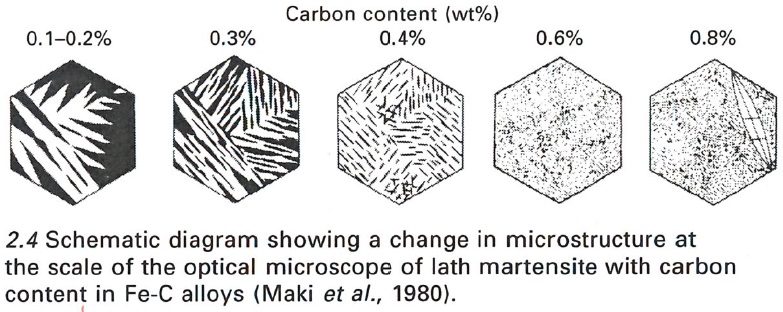
What Makes Quenched Steel so Hard?
Update: I have started a Patreon page to fund research projects which you can read about here – http://knifesteelnerds.com/how-you-can-help/
To harden steel you heat it up to high temperature to form a phase called austenite, followed by rapid quenching to make a very strong phase called martensite. Hardness is a measure of strength. I covered the process of austenite formation in the following post: Austenitizing Part 1. To summarize that post:
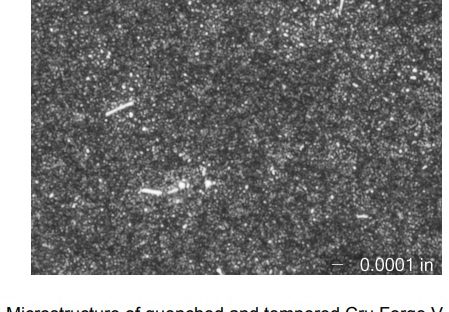
Cru Forge V – Toughness testing, Processing, and Background
Cru Forge V was developed by Crucible for those who forge their steel for knives [1]. It was developed shortly before Crucible’s bankruptcy and is reported to have been tested with the help of knifemakers Howard Clark and Dan Farr and that the code name prior to its official name was 1086V [2]. The steel is not listed anywhere on Crucible’s website and does not appear to be in production any longer, but as of March 2018 is still available from some third party steel sellers [3][4][5]. The steel has the following composition [1]:
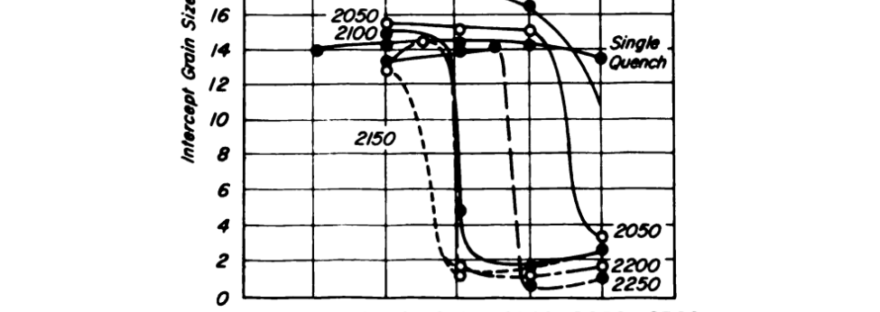
Austenitizing Part 3 – Multi-Step Austenitizing
There are many modifications to a straight high temperature austenitize for a given hold time followed by quenching. I am covering a few of them in this article.
Preheating
Preheating is performed to minimize size change, distortion, and cracking during heat treatment. Often a single preheating is recommended, but for some grades two preheating temperatures are recommended. For example, the Vanadis 4 Extra datasheet recommends a first preheat temperature of 600-650°C and a second of 850-900°C, such as in the following schematic [1]:
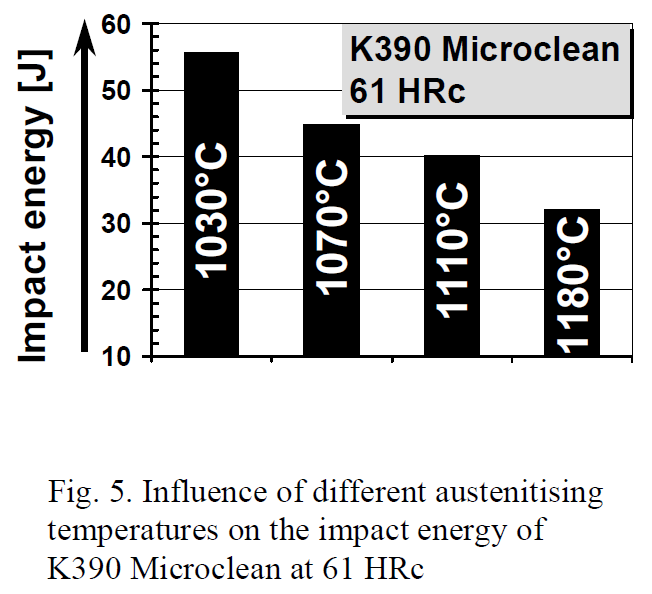
Austenitizing Part 2 – Effects on Properties
Carbide Volume
As covered in Part 1, carbide volume decreases with increasing temperature. As an example, here are micrographs showing carbides in a spray-form version of the original Vanadis 4 (non-Extra) [1]:

Austenitizing Part 1 – What it is
Update 7/6/2018: Since the writing of the original article I found some excellent micrographs that show austenitization very well and serve as a good supplement to the schematic diagrams. Go to the bottom of the article to see them.
I consider this site an excellent source for information, I learn something every time I visit.
Have a Bench Made Tagged Out Magna cut. Very tough so far
Ciao Larrin,trovo molto utile questo sito,
Avrei una domanda riguardo all’acciaio A8mod:come é meglio temprarlo per raggiungere la massima durezza?