
Category: Toughness
7 thoughts on “Toughness”
Leave a Reply
Tests of Knife Edge Toughness
Thanks to Jaethan Reichel for becoming a Knife Steel Nerds Patreon supporter!
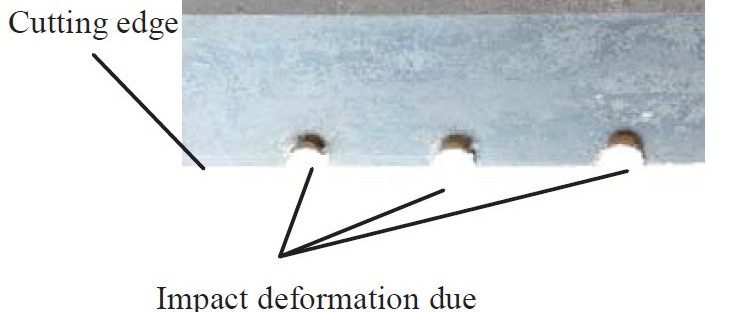
In an earlier article I wrote about the microscopic mechanisms by which chipping and micro-chipping occurs in edges. However, that article did not cover specific tests of edge toughness. Correlating conventional toughness tests with edge toughness is difficult for many reasons:
Toughness testing – Cru-Wear, Z-Wear, Upper vs Lower temper, Cryo vs No Cryo
Thanks to Paul Hart and James Covington for becoming Knife Steel Nerds Patreon supporters!
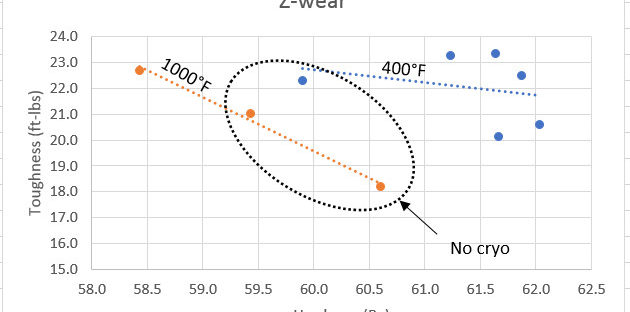
I recently completed some toughness tests on samples that were heat treated by knifemaker Warren Krywko. The steel was donated by Chuck Bybee of Alpha Knife Supply. The samples are subsize unnotched charpy specimens with dimensions as specified on the bottom of this page: http://knifesteelnerds.com/how-you-can-help/ If we can get more people to make toughness specimens we can have more comparisons between steels, hardness points, heat treatment parameters, etc. Patreon dollars are for the purpose of paying for machining, shipping, testing, etc. for tests like toughness and CATRA edge retention, so if you are able to contribute that way please visit the Knife Steel Nerds Patreon page.
How Chipping of Edges Happens at a Microscopic Level
Thanks to Warren Krywko, Joseph Cannell, and Timothy Thomas for becoming Knife Steel Nerds Patreon supporters! Your contributions will help fund more research on knife steels.
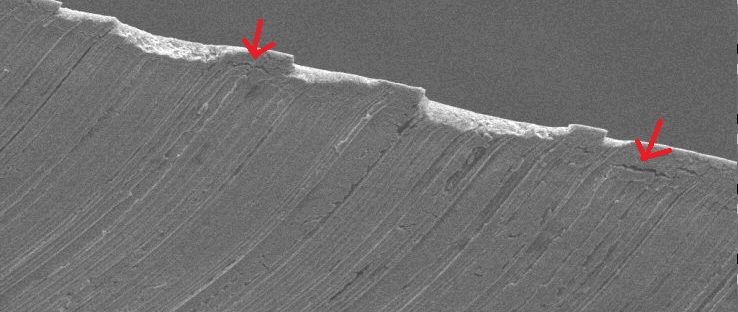
To discuss chipping we have to start with fracture mechanics of materials, and in this case steel. Chipping itself is just fracture, so by definition resistance to chipping is controlled by toughness. Unfortunately there are many definitions of toughness. I covered one definition of toughness in the article on spider silk, which is the area underneath the stress-strain curve:
Cru Forge V – Toughness testing, Processing, and Background
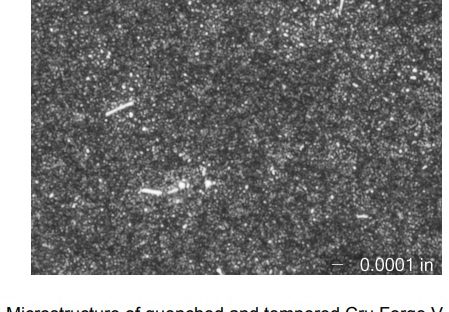
Cru Forge V was developed by Crucible for those who forge their steel for knives [1]. It was developed shortly before Crucible’s bankruptcy and is reported to have been tested with the help of knifemakers Howard Clark and Dan Farr and that the code name prior to its official name was 1086V [2]. The steel is not listed anywhere on Crucible’s website and does not appear to be in production any longer, but as of March 2018 is still available from some third party steel sellers [3][4][5]. The steel has the following composition [1]:
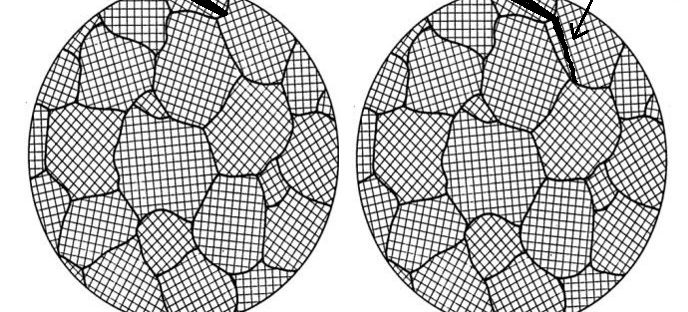
How Does Grain Refinement Lead to Improved Properties?
Update 6/21/2018: A new journal article has been released on the effect of grain size which is very interesting. I have added a brief summary of it at the bottom of this article.
In my posts on austenitizing I described parameters of heat treating to keep grain size as small as possible and therefore improve strength and toughness [1-3]. It is very difficult to improve both strength and toughness at the same time, usually increasing one decreases the other. By what mechanism does grain refinement improve both?
You should make a Facebook page
Just out of curiosity, did you ever test ztuff with a high temper. At one time I did some testing, and found it to be much tougher if tempered at around 1000 degrees. This was compared to tempering at 400 degrees!
I haven’t tested the high temper on Z-Tuff.
I think it would score quite a bit higher on you’re charts! Maybe in the future I could heat treat a few samples and send them to you. I’m interested personally!
Why is there a huge discrepancy with 14c28n toughness results. Older charts Say it’s a 3. I’ve abused my Kershaw blur since 2013 and never had issues. You have it at a 9 I think. Which is fantastic
Is DC53 tougher than 14c28N? Google ai says that it is. But it explains that DC53 is twice as tough as D2. Which D2 is not that tough. As far as I understand, 1.4116 is tougher, and I found a chart that says it’s rated as a 2.5 out of ten. When 14C28N is a 9 out of ten.
I have not tested DC53 but it would be unlikely to be tougher than 14C28N. I wouldn’t bother asking any AI these types of questions. My tests for A2 were around 15 ft-lbs. A2 has the same carbon but 3% lower chromium, which would likely give it an advantage in toughness over DC53.