
Category: Steels
4 thoughts on “Steels”
Leave a Reply
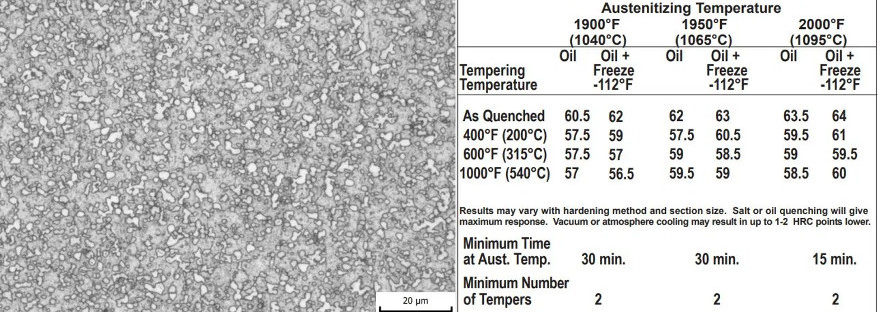
S30V Steel – History and Properties
Thanks to Atlas Knife & Tool and Mervin Thomson for become Knife Steel Nerds Patreon supporters!
We now have initial edge retention results from 32 steels on Patreon, so if you want an early look at that come join us on Patreon.
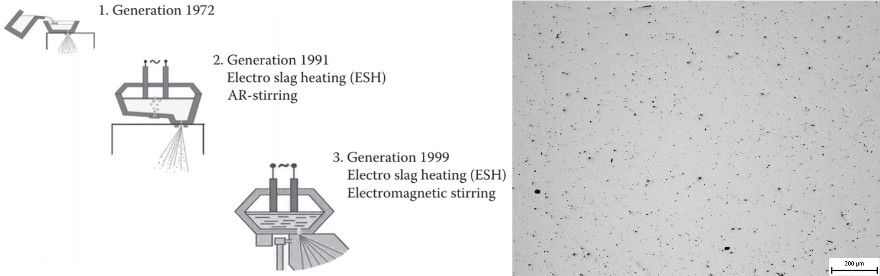
M390 vs 20CV vs 204P – 3rd Generation Powder Metallurgy Technology?
Thanks to Josh Warren and Alex K for becoming Knife Steel Nerds Patreon supporters!
Edge retention testing is continuing, we have now tested 18 different steels, and four of those steels with multiple heat treatments. Come to Patreon if you want updates on testing as it is completed.
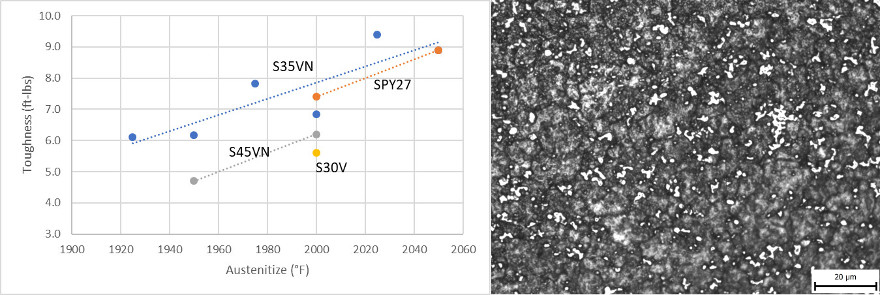
CPM SPY27 Experiments – Toughness, Corrosion Resistance, and More
Thanks to A.N. Nash, Matt Collingwood, Noah Cowan, James Pierce, and Jay Caponetti for becoming Knife Steel Nerds Patreon supporters!
I have a new CATRA edge retention testing machine. I will be posting results as they come in to Patreon and articles summarizing the tests will come later to this website. If you want to see tests as they are completed come join us on Patreon.
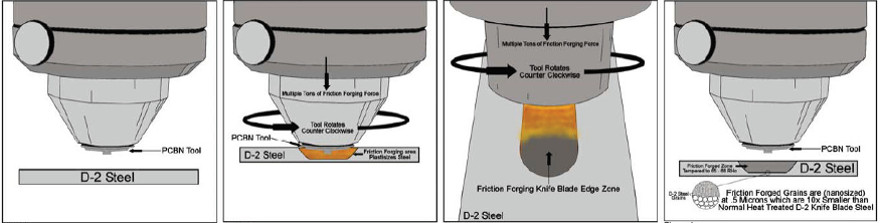
Friction Forged Knives – Diamondblade Friction Stir Processing
Thanks to Keith Coleman, Paul Bruno, Lotiel Vardamir, and Lennart Palkovits for becoming Knife Steel Nerds Patreon supporters!
Friction Forged Knives
The company DiamondBlade Knives produces knives with friction stir processed (FSP) edges [1]. Diamondblade Knives is a sub-company of Knives of Alaska. They use conventional D2 tool steel and process the edge so that it has hardness of around 65-69 Rc and a spine at 38-42 Rc. The knives are advertised as having a finer grain structure than powder metallurgy stainless steel and superior edge retention, toughness, and sharpness than knives tested in 12 other blade steels including S90V. And that the friction forged edge is stainless unlike conventionally processed D2. So I am going to detail the process used to produce the knives and what the properties of the steel likely are.
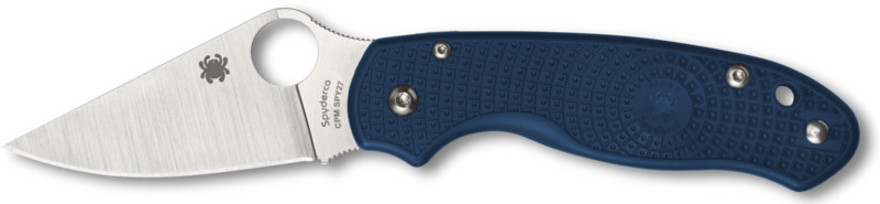
Spyderco-Exclusive CPM SPY27 Steel Analysis
Thanks to ShavedAlpaca, giorgi chubinidze, and Сергей Якунин for becoming Knife Steel Nerds Patreon supporters!
Update 3/10/2020: We did a range of experiments with SPY27 to supplement the estimates in this article. You can read those experiments here.
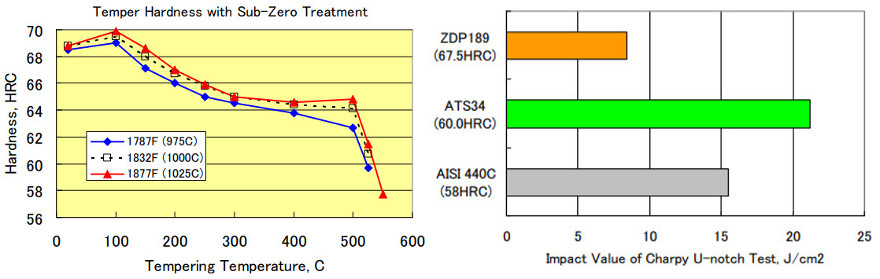
ZDP-189 and Cowry-X – Super Steel or Overrated?
Thanks to Aaron T Grote, J. Braun, Mr. KnifeGuy, jethro fluegel, Philip Ward, and Matt Peterson for becoming Knife Steel Nerds Patreon supporters!
ZDP-189 and Cowry-X
ZDP-189 is a steel produced by Hitachi and Cowry-X is produced by Daido. I have not been able to find much background information on the development of these steels. Sal Glesser of Spyderco reported he first heard about ZDP-189 around the year 2000 [1], and the earliest reference I have found to Cowry-X on Bladeforums in 2001 [2]. So both of the steels have been around for some time. The fact that two companies released essentially the same product perhaps indicates that the steel was not patented, which means little information would be available about its development. Both steels have an interesting composition with 3% carbon and 20% chromium along with a few other small additions. There are a few different reported compositions for ZDP-189 in terms of the Mo, V, and W content but below is from Spyderco.
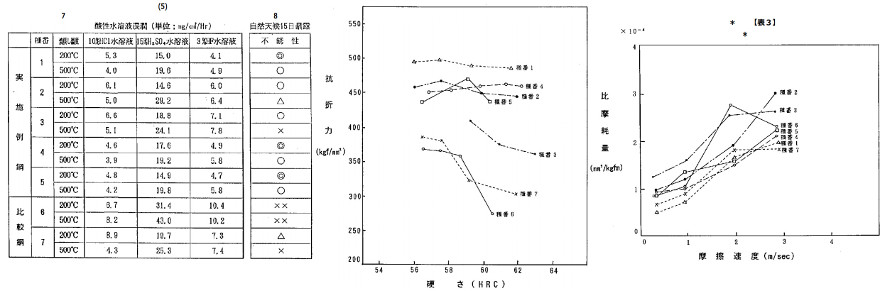
VG10 and Super Gold 2 – Takefu Stainless Steel Properties and History
Thanks to Larry Elletson, Tim Sigwarth, Steve Matthes, Curtis Seizert, Kristian Gasparius, and Will Collins for becoming Knife Steel Nerds Patreon supporters! We now have over 150 supporters!
History of VG10
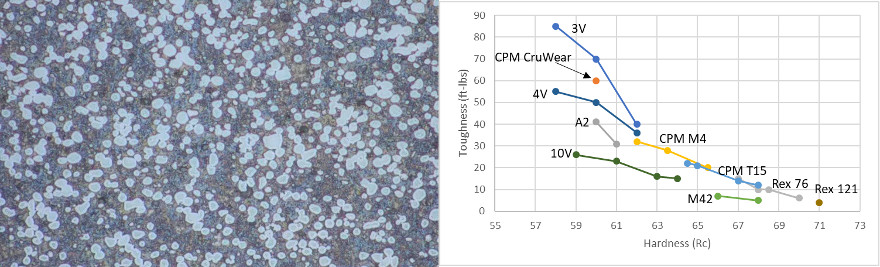
Super Hard (70 Rc) High Speed Steels – Maxamet, Rex 121, and More Explained
Thanks to Roberto J. Rodriguez and J. Kelley for becoming Knife Steel Nerds Patreon supporters! We only need a few more for 150 supporters!
Super Hard High Speed Steels
The super hard high speed steels (>68 Rc or so) are interesting from the standpoint of knife enthusiasts and knifemakers, particularly since knives are so often produced in the 58-61 Rc range. The metallurgy of these types of steels is also interesting. But before we get to what exactly these steels are and how they work, it makes sense to look at what led to their development first.
Sandrin Carbide – What is it?
Thanks to Justin Anthony, Stephen Pastore, David Singer, Chester Dussault, Joseph M. Lewanowicz, Mike Opitz, Murray Fox, and Robert Hatcher for becoming Knife Steel Nerds Patreon supporters!
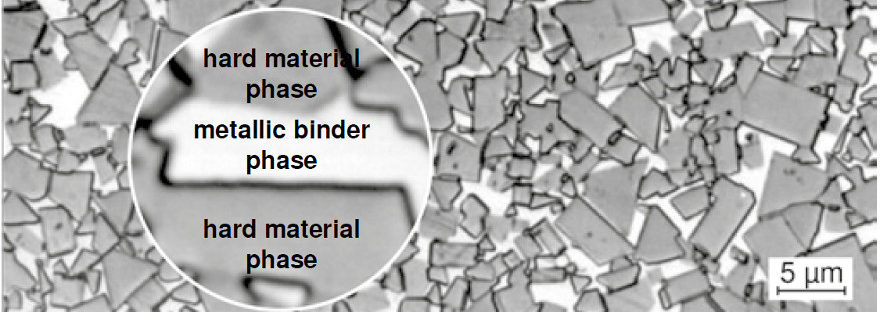
Cemented Carbide
Crucible S45VN Steel – Everything You Need to Know
Thanks to John Dyess, Michael Foote, Xun Fan, and Mark Vanderwest for becoming Knife Steel Nerds Patreon supporters!
Thanks to Niagara Specialty Metals for getting me a bar of S45VN for the experiments necessary for this article.
Thanks for what you are doing. There is so much misinformation, hyperbole, and exaggeration being presented as fact on the internet regarding knife blade steel. I felt like the skies cleared when I discovered your site. I really appreciate your science-based approach to demystify so many issues.
Thanks!
Can you tell me about AR-RPM9 please?
Thanks,
Mine S
I’ve only written about AR-RPM9 in an article exclusive to the Knife Steel Nerds Patreon.