Category: Heat Treating and Processing
3 thoughts on “Heat Treating and Processing”
Leave a Reply
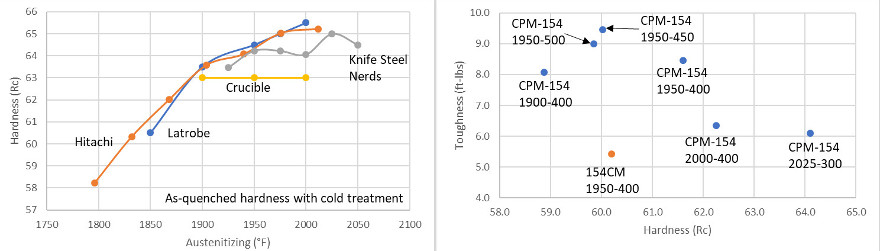
How to Heat Treat CPM-154 – Toughness Experiments
Thanks to Mikolai Kawai and Tyyreaun for becoming Knife Steel Nerds Patreon supporters!
I have now published two CATRA edge retention testing updates to Patreon for those that want a preview of testing before a full article will eventually be written.
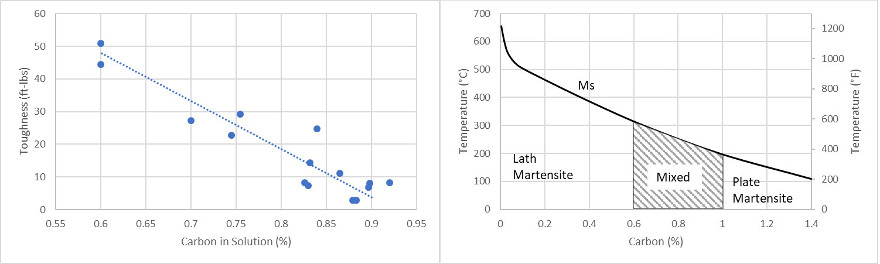
Ranking Toughness of Forging Knife Steels
Thanks to Dinkma, Gavel John, and Roger Rozenberg for becoming Knife Steel Nerds Patreon supporters!
Low-Alloy Steel Testing
Over the past two years or so we have tested the toughness of many knife steels using a simple charpy impact test. You can read about the specifications of the test on this page. With the samples tested in this article I got a lot of help from Warren Krywko and Devin Thomas as well as donated steel from Alpha Knife Supply, Barmond Special Steels, and Achim Wirtz. This article focuses on the toughness testing performed on “low alloy” and carbon steels that are often used by forging bladesmiths. It is possible to forge high alloy steels, of course, though it does not appear to be very common even today.
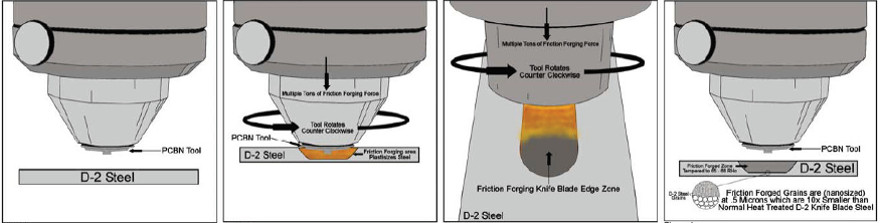
Friction Forged Knives – Diamondblade Friction Stir Processing
Thanks to Keith Coleman, Paul Bruno, Lotiel Vardamir, and Lennart Palkovits for becoming Knife Steel Nerds Patreon supporters!
Friction Forged Knives
The company DiamondBlade Knives produces knives with friction stir processed (FSP) edges [1]. Diamondblade Knives is a sub-company of Knives of Alaska. They use conventional D2 tool steel and process the edge so that it has hardness of around 65-69 Rc and a spine at 38-42 Rc. The knives are advertised as having a finer grain structure than powder metallurgy stainless steel and superior edge retention, toughness, and sharpness than knives tested in 12 other blade steels including S90V. And that the friction forged edge is stainless unlike conventionally processed D2. So I am going to detail the process used to produce the knives and what the properties of the steel likely are.
S35VN Steel – Properties and How to Heat Treat
Thanks to Konstantinos Noulis, Neil MacEachern, and J Kane Searcy for becoming Knife Steel Nerds Patreon supporters!
S35VN Steel History
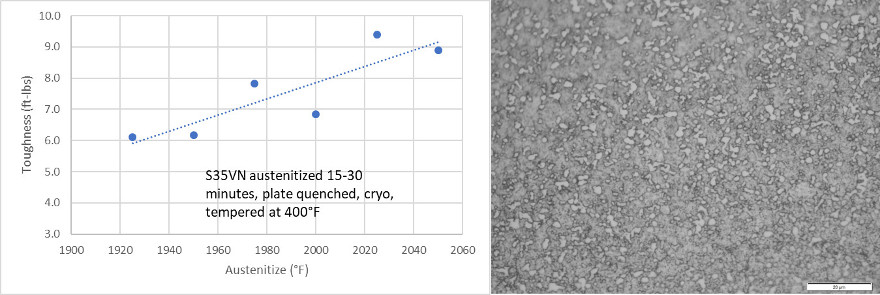
S35VN is a steel developed and produced by Crucible Industries, released in 2009. The steel was developed by Maria Sawford as a modification of S30V by reducing the vanadium content, adding 0.5% niobium, and removing the nitrogen addition (incidental nitrogen is still present). Powder metallurgy steels typically have at least 0.03% nitrogen [1][2]. These changes led to a steel with improved toughness and machinability relative to S30V at the cost of some edge retention. Heat treatment response and corrosion resistance remained approximately the same as S30V. More information on the history leading up to S35VN can be seen in this article on the newer S45VN.
Nitro-V – Its Properties and How to Heat Treat It
Thanks to Brad Ettinger, James Henley, and Edgar Candela for becoming Knife Steel Nerds Patreon supporters!
Nitro-V Steel
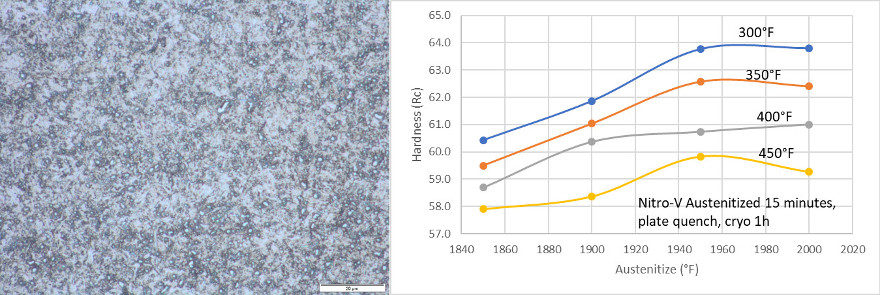
Nitro-V is a stainless steel sold by New Jersey Steel Baron which was first released in 2017 [1]. The steel was designed and produced in collaboration with Buderus Steel as a version of Uddeholm AEB-L modified with nitrogen and vanadium. Another obvious comparison is with 14C28N which was designed as a version of 13C26 modified for improved corrosion resistance. 13C26 is nearly identical to AEB-L but produced by Sandvik. You can read more about the history of AEB-L, 13C26, and 14C28N in this article.
The History of Powder Metals in Damascus Steel
Gratitude
Thanks to cbw, Doug Siddens, Nick Dunham, and Robert Martin for becoming Knife Steel Nerds Patreon supporters!
I interviewed several knifemakers for this article. Thanks to Ed Schempp, Hank Knickmeyer, Steve Schwarzer, Rick Dunkerley, Jim Batson, Shane Taylor, Jeff Carlisle, Kelly Cupples, Daryl Meier, John Davis, Matt Diskin, Wade Colter, Barry Gallagher, Howard Clark, Bob Kramer, and Devin Thomas for talking to me.
Forged vs Stock Removal Knives
Thanks to Colin Fergus and funny_name_here for becoming Knife Steel Nerds Patreon supporters!
Forging by the Steel Company vs Bladesmith
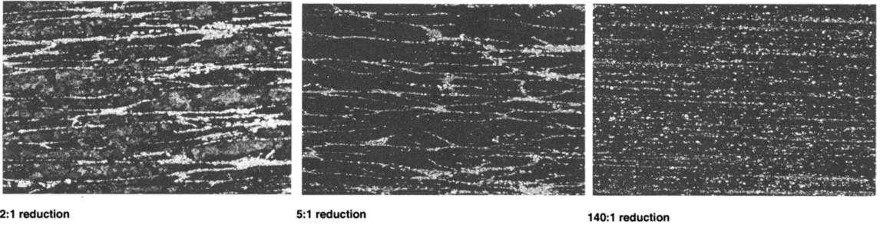
When the steel company makes the steel they produce a large melt of the steel with the desired composition and pour it into a mold which solidifies and produces an ingot. A typical ingot size for tool steel or high speed steel might be 10″ thick either round or square depending on the production process and the desired final shape. Smaller ingots are better for limiting the segregation of alloying elements and keeping the cast structure fine. At that point the steel is in “cast” form. The ingot is then heated up to high temperature and forged either with a hammer or press to a form ready for hot rolling. In some cases the ingot is ready for rolling as-produced. Next the steel is hot rolled to the final desired thickness. Hot rolling in an industrial setting is typically done with relatively few reheats, typically single digits. That depends on how much reduction in necessary, how difficult the steel is to work, and the capability of the rolling mill.

The Secret Heat Treatment of Frank J. Richtig
Thanks to Dean Baughman, Kitoc420, Steve Callari, Jay Ghoo, and Mitch Cagile for becoming Knife Steel Nerds Patreon supporters!
Legendary Heat Treatments
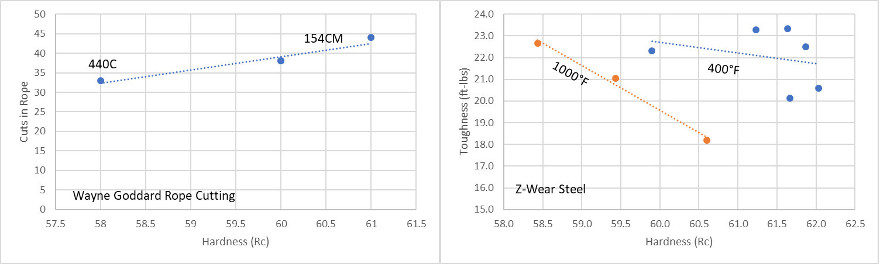
Last week I wrote about What a Good Heat Treatment Can and Cannot Do, and as part of that topic I wrote about how some knifemakers have a legendary or even mythical reputation for their heat treatments. In that article I argued that the big differences are between “bad” and “good” heat treatments, and that the differences between various good heat treatments are much smaller. And that edge geometry and knife design are more important to knife performance than the differences that are possible between different “good” heat treatments. So I think it makes sense to discuss a particular case of a knifemaker known for legendary, unmatched heat treatments, which brings me to…
What a Good Heat Treatment Can and Cannot Do
Thanks to C6 MFG and Dan Swaney for becoming Knife Steel Nerds Patreon supporters!
The Legend of Heat Treatment
There is some debate about knives that have steel with a “good heat treatment” vs those that have a bad or sub-par heat treatment. Some knifemakers have a near legendary reputation for their excellent heat treatments. What exactly is possible in terms of heat treating? How much better can steel be? How bad can it get?
Annealing Part 2 – Temper Annealing, Cycling, and Final Properties
Thanks to Ryan Rodriguez and Matt Peter for becoming Knife Steel Nerds Patreon supporters!
I was interviewed by Shawn Houston on his Youtube channel about the micrographs article. See the video here.
Background
I consider this site an excellent source for information, I learn something every time I visit.
Have a Bench Made Tagged Out Magna cut. Very tough so far
Ciao Larrin,trovo molto utile questo sito,
Avrei una domanda riguardo all’acciaio A8mod:come é meglio temprarlo per raggiungere la massima durezza?