Author: Larrin
How to Design Knives that Do Not Fail
Thanks to Tom Krein, Joshua Goldstein, Matthew Maola, Edo Vernoschi, Nils Anderssen, and Cedric & Ada for becoming Knife Steel Nerds Patreon supporters!
Failure Modes
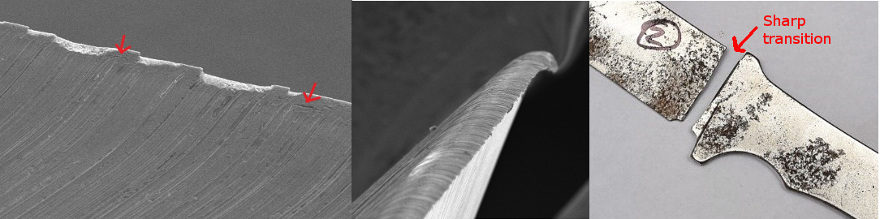
A common engineering technique is to evaluate designs based on how they failed, or may fail. Failure modes are identified and the designs are modified to prevent those failures. These ideas are simple in concept but it is surprising how easy it can be to miss the forest for the trees. In terms of predicting failure modes in some cases it is easy and in some it is difficult. You would expect a large chopping knife to require heavier edge geometry to prevent chipping and rolling, or a seawater diving knife to require high rust resistance. Other times failure modes are identified through testing of the knife or by returns from customers. Whatever the source of the failure, there are usually relatively simple methods for fixing each one, though the trade-offs for doing so may not be desirable.
XHP Steel – History and Properties
Thanks to John Bates, Kenny Lazarus, Robert Abel, and Matt Danielson for becoming Knife Steel Nerds Patreon supporters! I have some exclusive Patreon supporter content this week. Pete of the Cedric and Ada Youtube channel posted this past week a video summarizing his rope cut tests on 14 Spyderco Mule knives in different steels. This is a fun test because all of the knives are nearly identical and only the steel and heat treatment is different, so it is a better steel comparison than some of the others between different knives. I already have a previous article where I compared CATRA testing to rope cutting so this new test didn’t warrant a whole new article, but I offered an analysis of his test for Patreon.
Forged vs Stock Removal Knives
Thanks to Colin Fergus and funny_name_here for becoming Knife Steel Nerds Patreon supporters!
Forging by the Steel Company vs Bladesmith
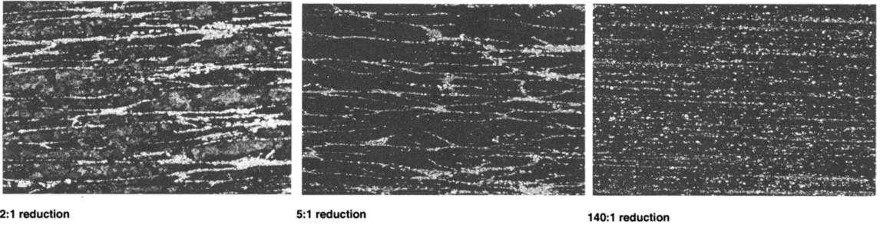
When the steel company makes the steel they produce a large melt of the steel with the desired composition and pour it into a mold which solidifies and produces an ingot. A typical ingot size for tool steel or high speed steel might be 10″ thick either round or square depending on the production process and the desired final shape. Smaller ingots are better for limiting the segregation of alloying elements and keeping the cast structure fine. At that point the steel is in “cast” form. The ingot is then heated up to high temperature and forged either with a hammer or press to a form ready for hot rolling. In some cases the ingot is ready for rolling as-produced. Next the steel is hot rolled to the final desired thickness. Hot rolling in an industrial setting is typically done with relatively few reheats, typically single digits. That depends on how much reduction in necessary, how difficult the steel is to work, and the capability of the rolling mill.
Carbide Types in Knife Steels
Thanks to Todd Kroenlein and David for becoming Knife Steel Nerds Patreon supporters!
Cementite
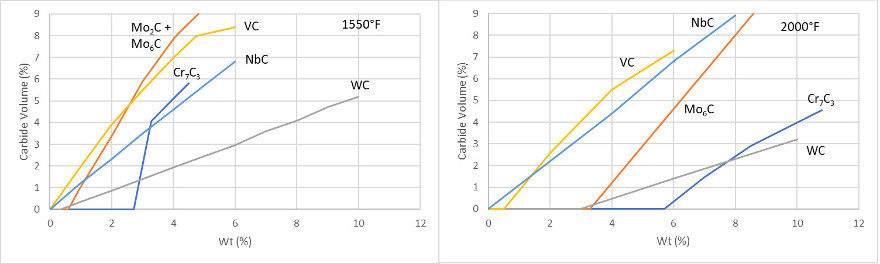
The most basic carbide type in steel is an intermetallic compound formed between iron and carbon, commonly called cementite. Carbides are hard and brittle, similar to a ceramic material. Cementite has a relatively complex structure but in its simplest form it is 3 iron atoms for every carbon atom: Fe3C. However, other elements can partially replace the iron, so the carbide is sometimes given as M3C where M can mean Fe, Mn, Cr, etc. Cementite is typically present as either particles or in “pearlite.” I introduced what pearlite is in this article. However, cementite is the only carbide type that typically forms in pearlite, so to keep things simple for this article I will be focusing on carbide particles. Below I have a schematic representation of carbides (black circles) along with the grain boundaries (black lines).

The Secret Heat Treatment of Frank J. Richtig
Thanks to Dean Baughman, Kitoc420, Steve Callari, Jay Ghoo, and Mitch Cagile for becoming Knife Steel Nerds Patreon supporters!
Legendary Heat Treatments
Last week I wrote about What a Good Heat Treatment Can and Cannot Do, and as part of that topic I wrote about how some knifemakers have a legendary or even mythical reputation for their heat treatments. In that article I argued that the big differences are between “bad” and “good” heat treatments, and that the differences between various good heat treatments are much smaller. And that edge geometry and knife design are more important to knife performance than the differences that are possible between different “good” heat treatments. So I think it makes sense to discuss a particular case of a knifemaker known for legendary, unmatched heat treatments, which brings me to…
What a Good Heat Treatment Can and Cannot Do
Thanks to C6 MFG and Dan Swaney for becoming Knife Steel Nerds Patreon supporters!
The Legend of Heat Treatment
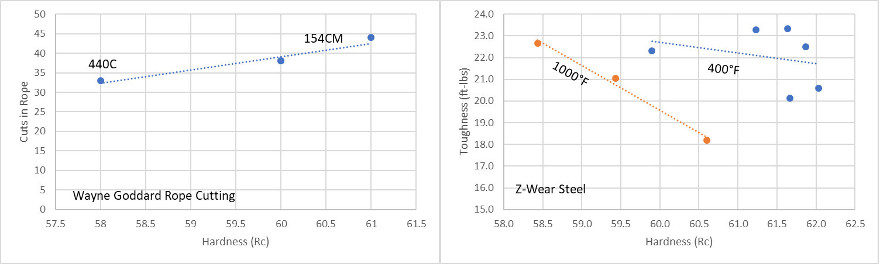
There is some debate about knives that have steel with a “good heat treatment” vs those that have a bad or sub-par heat treatment. Some knifemakers have a near legendary reputation for their excellent heat treatments. What exactly is possible in terms of heat treating? How much better can steel be? How bad can it get?
H1 Steel – How it Works
Thanks to Guns N’ Loaded for becoming a Knife Steel Nerds Patreon supporter!
Austenitic Stainless Steels
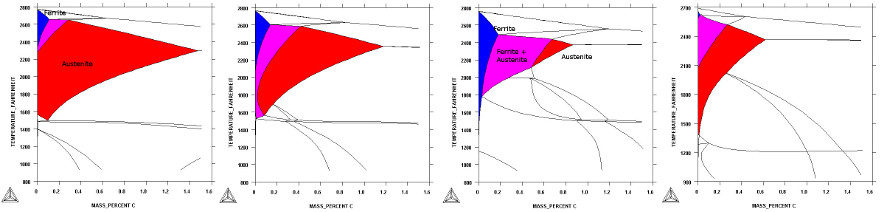
At its most basic, H1 is an austenitic stainless steel. Austenitic stainless steels are about as old as stainless steel itself, being developed by German metallurgists in the approximate time period of 1909-1912. They worked on 18% Cr, 8% Ni steels which are quite similar to common austenitic stainless steels like 301, 302, and 304.
Annealing Part 2 – Temper Annealing, Cycling, and Final Properties
Thanks to Ryan Rodriguez and Matt Peter for becoming Knife Steel Nerds Patreon supporters!
I was interviewed by Shawn Houston on his Youtube channel about the micrographs article. See the video here.
Background
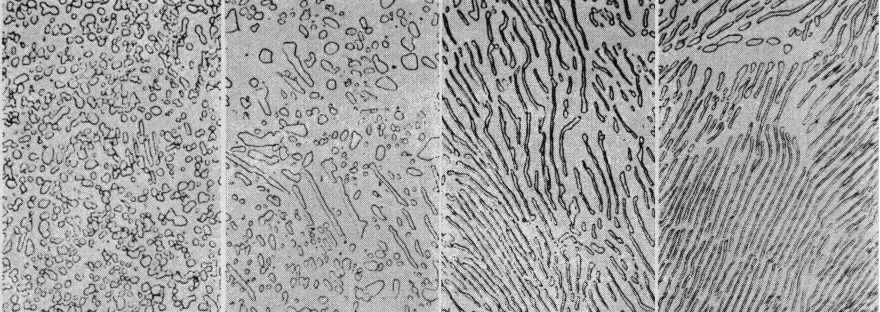
How Annealing of Steel Works – Subcritical vs Transformation Annealing
Thanks to Larry Corsa and Gene Kimmi for becoming Knife Steel Nerds Patreon supporters!
Why Anneal?
There are three primary goals of annealing steel:
- Make the steel machinable so that it can be easily cut, drilled, and ground.
- Setup the steel for austenitizing and quenching (hardening) so that is has good heat treating response
- Provide the best possible properties in the final heat treated product
The above goals are not always 100% compatible, but we would like to offer the optimal combination based on our priorities. However, to know what the trade-offs are we need to know how annealing works first.
The History of 3V, Cru-Wear, and Z-Tuff Steel
Thanks to Patrick Gosselin for becoming a Knife Steel Nerds Patreon supporter!
Thanks to Kenneth Pinnow for talking to me about 3V steel development, Gary Maddock for talking to me about PD#1, CD#1, PD#5, Z-Wear, and Z-Tuff, and Mark Zalesky and Clay Aalders for getting me a scan of a 1979 Knife World article about Vasco Wear.