
Category: Toughness
7 thoughts on “Toughness”
Leave a Reply
Vanadis 8 – Better than CPM-10V
Thanks to Will and Justin Mann for becoming Knife Steel Nerds Patreon supporters!
My book Knife Engineering is available for Christmas and Hanukkah presents.
History of Vanadis 8
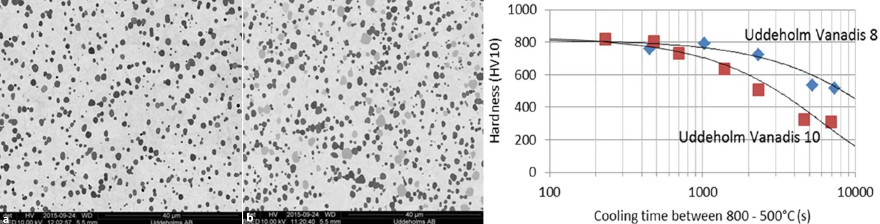
The history of Vanadis 8 goes back a lot further than just the steel itself, really we have to know the history of 10V to know all of the background that is relevant. You can read about CPM-10V in this article. CPM-10V is important because Vanadis 8 is intended as a replacement for CPM-10V, or at least for similar applications. CPM-10V was developed by Crucible in the late 70s, as the first powder metallurgy steel to utilize a microstructure made up of only vanadium carbide, as opposed to chromium and molybdenum/tungsten carbides. This gave 10V a combination of good toughness along with very high wear resistance from the ~10% vanadium and therefore ~17% vanadium carbide.
CPM-S110V Steel – History and Properties
Thanks to Aaron @ Gough Custom, Aaron McVay, Mark Scott, Jeffrey St. Claire, Grant Seim III, and saiiiiiii1 for becoming Knife Steel Nerds Patreon supporters!
I’m eventually going to stop plugging my book Knife Engineering in every new article, but that day is not today. Go buy one for yourself, and everyone you know, as a Christmas present.
M398 Steel Testing – Edge Retention, Toughness, and More
Thanks to Joel Sunderland for becoming a Knife Steel Nerds Patreon supporter! And thanks to pog for increasing their support.
The steel ratings table from my new book Knife Engineering has now been added as a Patreon-exclusive with M398 added to the table.
Toughness Improvement of High Carbon Tungsten Steel 1.2562
Thanks to all the new Knife Steel Nerds Patreon supporters that have joined since our big article on CATRA testing. The response has been phenomenal. We only need 4 more supporters to reach 200! Brandon Percival, Jason Stone, Fixall, John Schmidt, Adam Ringgenberg, Adam Webb, Shah Paul, Andy, Chad Shoopman, Dylan Giagni, Adam Nolte, John Scarborough, Datafox, Ben Secrist, Noah, Josh – REK, Robert Towe, NJO, Dd, Andrew Bounds, Nathan Gee, and hsc3.
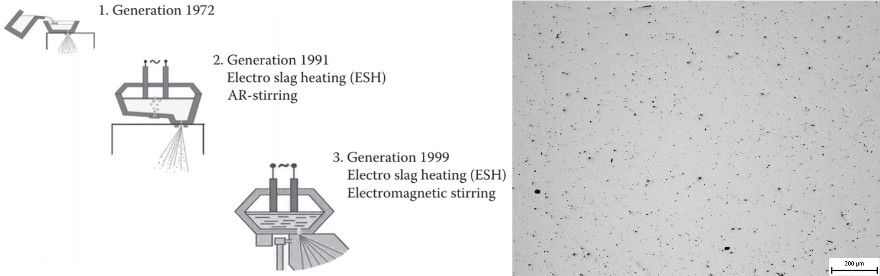
M390 vs 20CV vs 204P – 3rd Generation Powder Metallurgy Technology?
Thanks to Josh Warren and Alex K for becoming Knife Steel Nerds Patreon supporters!
Edge retention testing is continuing, we have now tested 18 different steels, and four of those steels with multiple heat treatments. Come to Patreon if you want updates on testing as it is completed.
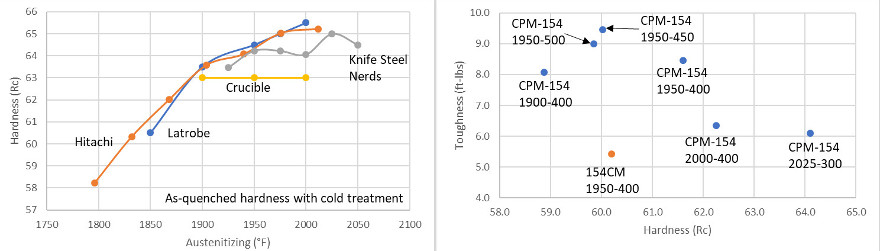
How to Heat Treat CPM-154 – Toughness Experiments
Thanks to Mikolai Kawai and Tyyreaun for becoming Knife Steel Nerds Patreon supporters!
I have now published two CATRA edge retention testing updates to Patreon for those that want a preview of testing before a full article will eventually be written.
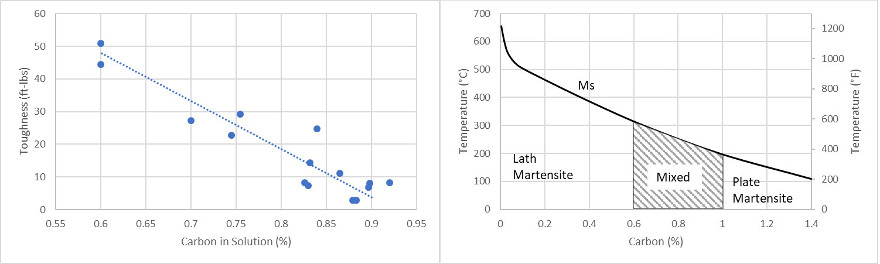
Ranking Toughness of Forging Knife Steels
Thanks to Dinkma, Gavel John, and Roger Rozenberg for becoming Knife Steel Nerds Patreon supporters!
Low-Alloy Steel Testing
Over the past two years or so we have tested the toughness of many knife steels using a simple charpy impact test. You can read about the specifications of the test on this page. With the samples tested in this article I got a lot of help from Warren Krywko and Devin Thomas as well as donated steel from Alpha Knife Supply, Barmond Special Steels, and Achim Wirtz. This article focuses on the toughness testing performed on “low alloy” and carbon steels that are often used by forging bladesmiths. It is possible to forge high alloy steels, of course, though it does not appear to be very common even today.
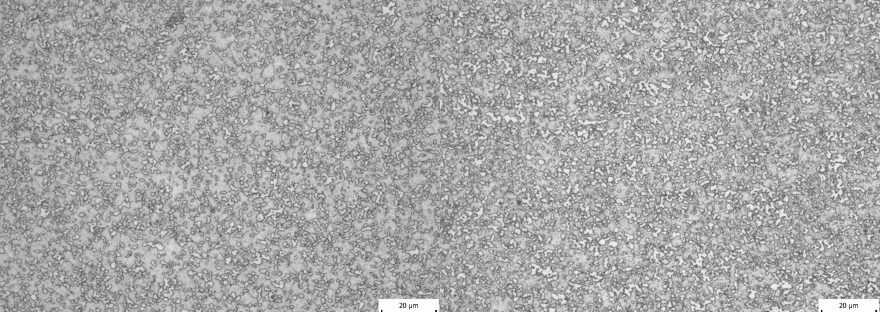
Crucible S45VN Steel – Everything You Need to Know
Thanks to John Dyess, Michael Foote, Xun Fan, and Mark Vanderwest for becoming Knife Steel Nerds Patreon supporters!
Thanks to Niagara Specialty Metals for getting me a bar of S45VN for the experiments necessary for this article.
Nitro-V – Its Properties and How to Heat Treat It
Thanks to Brad Ettinger, James Henley, and Edgar Candela for becoming Knife Steel Nerds Patreon supporters!
Nitro-V Steel
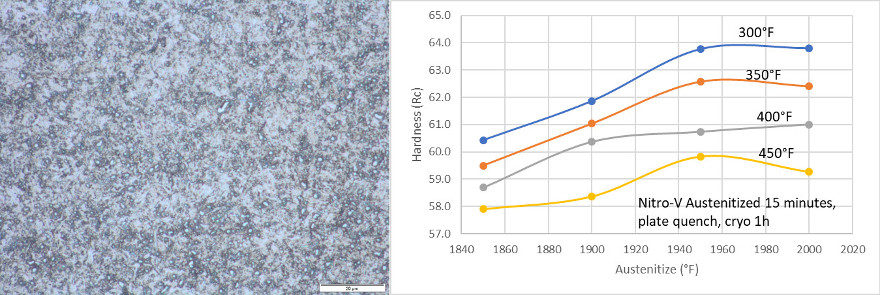
Nitro-V is a stainless steel sold by New Jersey Steel Baron which was first released in 2017 [1]. The steel was designed and produced in collaboration with Buderus Steel as a version of Uddeholm AEB-L modified with nitrogen and vanadium. Another obvious comparison is with 14C28N which was designed as a version of 13C26 modified for improved corrosion resistance. 13C26 is nearly identical to AEB-L but produced by Sandvik. You can read more about the history of AEB-L, 13C26, and 14C28N in this article.
How to Heat Treat 26C3 Steel
Thanks to Gene Boyd and Dan Bidinger for becoming Knife Steel Nerds Patreon supporters!
26C3 Steel
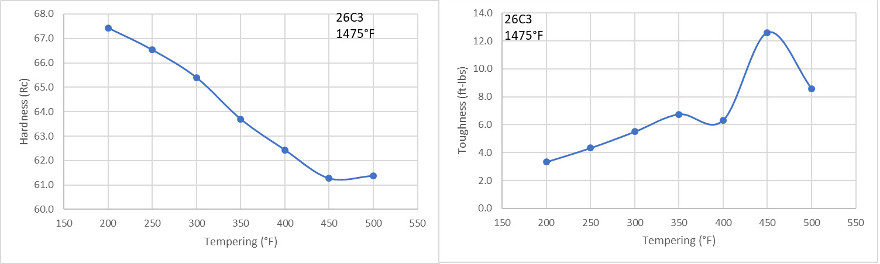
26C3 steel is produced by Uddeholmstrip (part of Voestalpine Precision Strip) as a razor and scalpel steel. This steel is also known as 1.2002 using the German designation. I don’t know much about the history of the steel but the marketing literature says, “voestalpine Precision Strip AB has long experience and were the pioneers of both the high carbon (UHB 26C3) and the martensitic stainless steel (UHB AEB-L) razor strip grades” [1]. In the 1927 patent for AEB-H [2], reference is made to “the purest Swedish carbon steel with ‘1.05% C and 0.4% Mn'” and in a 1970 patent for a razor blade steel there is a reference to UHB 26C (the 3 is not on the end) which has the same approximate composition as the current 26C3 [3]. So I think there was probably some evolution of the composition despite the claims of the marketing material. The composition of 26C3 is shown below:
You should make a Facebook page
Just out of curiosity, did you ever test ztuff with a high temper. At one time I did some testing, and found it to be much tougher if tempered at around 1000 degrees. This was compared to tempering at 400 degrees!
I haven’t tested the high temper on Z-Tuff.
I think it would score quite a bit higher on you’re charts! Maybe in the future I could heat treat a few samples and send them to you. I’m interested personally!
Why is there a huge discrepancy with 14c28n toughness results. Older charts Say it’s a 3. I’ve abused my Kershaw blur since 2013 and never had issues. You have it at a 9 I think. Which is fantastic
Is DC53 tougher than 14c28N? Google ai says that it is. But it explains that DC53 is twice as tough as D2. Which D2 is not that tough. As far as I understand, 1.4116 is tougher, and I found a chart that says it’s rated as a 2.5 out of ten. When 14C28N is a 9 out of ten.
I have not tested DC53 but it would be unlikely to be tougher than 14C28N. I wouldn’t bother asking any AI these types of questions. My tests for A2 were around 15 ft-lbs. A2 has the same carbon but 3% lower chromium, which would likely give it an advantage in toughness over DC53.