Category: Steel and Knife Properties
2 thoughts on “Steel and Knife Properties”
Leave a Reply
O1 Steel – History, Properties, and How to Heat Treat
Thanks to Johnny Ngo and ALtheSciencePal for becoming Knife Steel Nerds Patreon supporters!
O1 Steel History
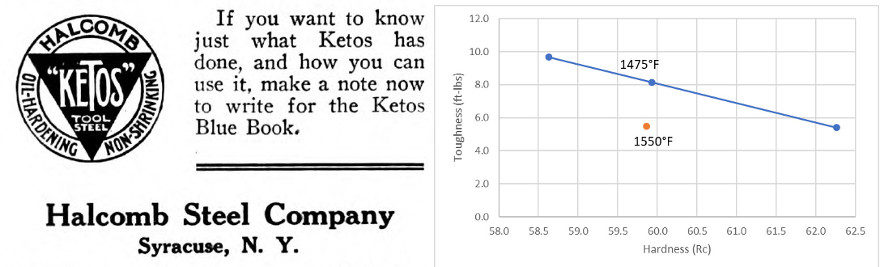
O1 steel was developed in 1905 by Halcomb steel which was acquired by Crucible Steel a few years later [1][2]. However, the history is a bit more interesting than that. In 1876 a large Sheffield steel company, Sanderson Brothers, purchased Sweet’s Manufacturing Company’s Geddes Steel Works in Syracuse New York. American tariffs had led to a large reduction in exported steel from Sheffield, and steel output from the USA had also greatly increased to match. So several English steel companies setup production facilities in the US, including Sanderson Brothers. Sanderson Brothers was a very old Sheffield steel company, founded in 1776. Tool Steel development began to explode starting in about 1900 due to the recent discovery of “high speed steel” which you can read about here: The History of the First Tool Steel. The year 1900 was doubly significant because in that year there was a major consolidation of 13 of the major steel plants which used “crucible” steel production methods, accounting for 95% of the crucible steel production in the United States.
How to Heat Treat 26C3 Steel
Thanks to Gene Boyd and Dan Bidinger for becoming Knife Steel Nerds Patreon supporters!
26C3 Steel
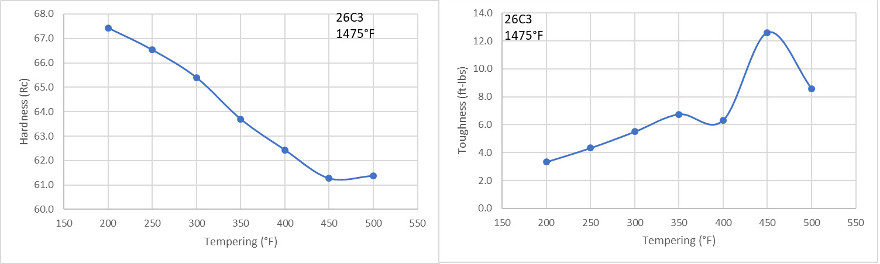
26C3 steel is produced by Uddeholmstrip (part of Voestalpine Precision Strip) as a razor and scalpel steel. This steel is also known as 1.2002 using the German designation. I don’t know much about the history of the steel but the marketing literature says, “voestalpine Precision Strip AB has long experience and were the pioneers of both the high carbon (UHB 26C3) and the martensitic stainless steel (UHB AEB-L) razor strip grades” [1]. In the 1927 patent for AEB-H [2], reference is made to “the purest Swedish carbon steel with ‘1.05% C and 0.4% Mn'” and in a 1970 patent for a razor blade steel there is a reference to UHB 26C (the 3 is not on the end) which has the same approximate composition as the current 26C3 [3]. So I think there was probably some evolution of the composition despite the claims of the marketing material. The composition of 26C3 is shown below:
How to Design Knives that Do Not Fail
Thanks to Tom Krein, Joshua Goldstein, Matthew Maola, Edo Vernoschi, Nils Anderssen, and Cedric & Ada for becoming Knife Steel Nerds Patreon supporters!
Failure Modes
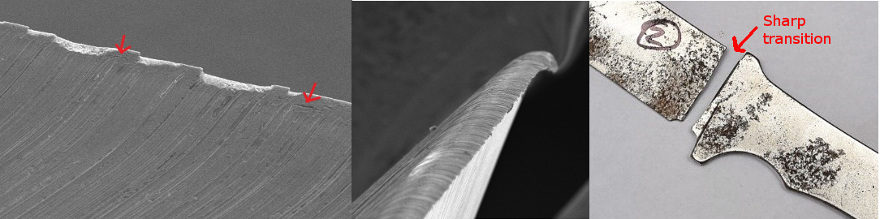
A common engineering technique is to evaluate designs based on how they failed, or may fail. Failure modes are identified and the designs are modified to prevent those failures. These ideas are simple in concept but it is surprising how easy it can be to miss the forest for the trees. In terms of predicting failure modes in some cases it is easy and in some it is difficult. You would expect a large chopping knife to require heavier edge geometry to prevent chipping and rolling, or a seawater diving knife to require high rust resistance. Other times failure modes are identified through testing of the knife or by returns from customers. Whatever the source of the failure, there are usually relatively simple methods for fixing each one, though the trade-offs for doing so may not be desirable.
Carbide Types in Knife Steels
Thanks to Todd Kroenlein and David for becoming Knife Steel Nerds Patreon supporters!
Cementite
The most basic carbide type in steel is an intermetallic compound formed between iron and carbon, commonly called cementite. Carbides are hard and brittle, similar to a ceramic material. Cementite has a relatively complex structure but in its simplest form it is 3 iron atoms for every carbon atom: Fe3C. However, other elements can partially replace the iron, so the carbide is sometimes given as M3C where M can mean Fe, Mn, Cr, etc. Cementite is typically present as either particles or in “pearlite.” I introduced what pearlite is in this article. However, cementite is the only carbide type that typically forms in pearlite, so to keep things simple for this article I will be focusing on carbide particles. Below I have a schematic representation of carbides (black circles) along with the grain boundaries (black lines).
H1 Steel – How it Works
Thanks to Guns N’ Loaded for becoming a Knife Steel Nerds Patreon supporter!
Austenitic Stainless Steels
At its most basic, H1 is an austenitic stainless steel. Austenitic stainless steels are about as old as stainless steel itself, being developed by German metallurgists in the approximate time period of 1909-1912. They worked on 18% Cr, 8% Ni steels which are quite similar to common austenitic stainless steels like 301, 302, and 304.
The History of 3V, Cru-Wear, and Z-Tuff Steel
Thanks to Patrick Gosselin for becoming a Knife Steel Nerds Patreon supporter!
Thanks to Kenneth Pinnow for talking to me about 3V steel development, Gary Maddock for talking to me about PD#1, CD#1, PD#5, Z-Wear, and Z-Tuff, and Mark Zalesky and Clay Aalders for getting me a scan of a 1979 Knife World article about Vasco Wear.
New Micrographs of 42 Knife Steels
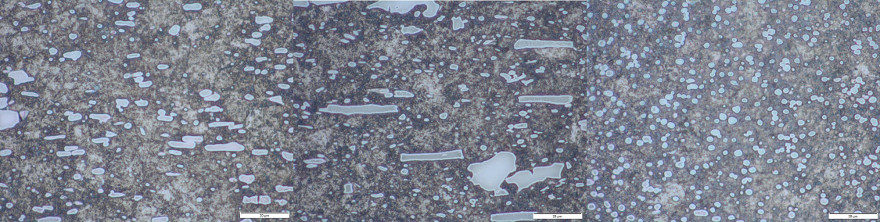
10/15/2020: I added M398, WFN, Nitrobe 77, and Vancron
2/24/2020: I added 420HC, CPM-T15, Rex 76, S125V, SPY27, and Z-Max/Rex 86
2/10/2020: I added 26C3, 1.2442, 1.2519, 1.2562, Blue Super, V-Toku 2, and A8 Mod.
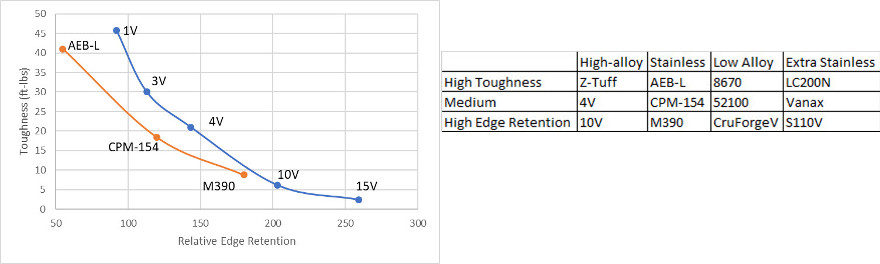
How to Pick the Best Steel for Every Knife
Update 2/19/2021: In the recommendations section I updated a few of my recommendations based on new experiments and new steels.
Thanks to Mau, Benjamin Amaral, Karolis Griskevicius, Dan Frazier, and Jess Hoffman for becoming Knife Steel Nerds Patreon supporters! We are now over 100 supporters!
How to Heat Treat 52100
Thanks to Lev Serebryakov for becoming a Knife Steel Nerds Patreon supporter!
52100 Steel
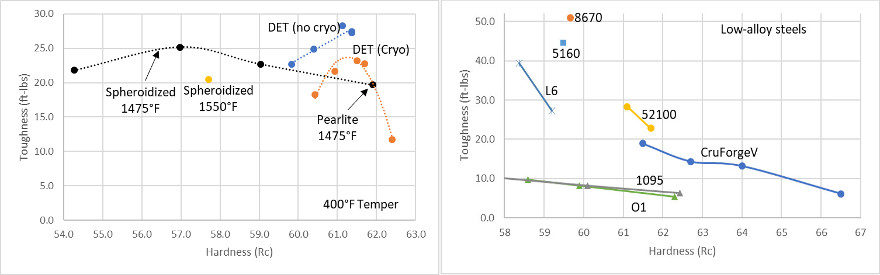
I previously wrote about the history and properties of 52100 in this article. The steel has been around since 1905, has been known as 52100 since 1919, and has been used in knives since at least the 1940’s. It was developed for bearings and its common use in bearings meant it has been a ready source for knife steel for decades. It is known for its fine carbide size and good toughness. The chromium addition compared with the chromium-free 1095 means that it has somewhat higher hardenability so it is easier to harden in oil and obtain full hardness. The chromium also helps keep the carbide size small. The chromium also shifts up the temperatures required for hardening.
A2 Steel – History and Properties
Thanks to Dan Pierson, Steve R. Godfrey, Bryan Fry, and Timothy Becker for becoming Knife Steel Nerds Patreon supporters!
History
A2 steel is quite old, though determining the exact year it was released is a bit difficult. A2 steel was developed in the early 20th century during the explosion of tool steels that occurred after the discovery of high speed steel which was first presented in 1900. You can read about that history in this article: The History of the First Tool Steel. During the development of the first high speed steel included the switch from manganese to chromium as the primary hardenability element, and most high speed steels had about 4% Cr. That high chromium content was primarily for “hardenability” which is the degree of cooling required to achieve full hardness. A “water quenching” steel has low hardenability and must be quenched very rapidly from high temperature, and an “air hardening” steel can be left in air and it will fully harden. You can read more about hardenability in this article on quenching. The first high speed steel came to be known as T1, which had 4% Cr and 18% W (tungsten). The earliest record I have found of a precursor A2-type steel is in a summary of tool steels in 1925 [1], while summaries of tool steels from 1910 [2] and 1915 [3] do not have any similar steels. Therefore these types of steels probably arose sometime between 1915 and 1925.
Those photos and drawings will help people understand ! Orientation – I was curious about what Crucible does with that .Their CPM goes to Niagra Metals for rolling and they cross roll the steel. Cut into squares and rolled alternating direction to minimize directional properties. I think Matt Gregory found that in his visit.
It would be interesting to test the transverse toughness of those steels for sure.