
Thanks to John Scarborough and Robert Angerer for becoming Knife Steel Nerds Patreon supporters!
Update 1/6/2020: I have since performed my own corrosion resistance testing and provided updated analysis.
Thanks to John Scarborough and Robert Angerer for becoming Knife Steel Nerds Patreon supporters!
Update 1/6/2020: I have since performed my own corrosion resistance testing and provided updated analysis.
Here at the beginning of 2019 I decided to write up a retrospective of Knife Steel Nerds so far. A lot of things happened in 2018. First of all, the Knife Steel Nerds website was started, with the first article being posted February 27, 2018. That first article was about a modified 3V steel developed and patented by Crucible but never sold as far as I know. Links to the website were not shared with anyone until March 8th, however.

Thanks to the Knife Steel Nerds Patreon supporters for an awesome 2018!
Introduction
Zvi, who goes by Gator97 on many forums, developed the website Zknives.com which contains many articles on various topics including many on knives and sharpening. He also has a steel composition database which is the largest ever made collecting essentially any steel ever used in knives. As far as I know it is the largest database of steel compositions of any type. The database is available on his website and as Android and iOS apps. Because of that very useful contribution to knife steel nerds, I asked Zvi if he would be willing to be interviewed and he graciously agreed.

Thanks to Tracy Mickley from becoming a Knife Steel Nerds Patreon supporter!
Steels become stronger at lower temperatures. This can be measured with the “yield strength” which is the load to permanently deform the steel. This deformation is in the form of a shape change, ie. if you are bending steel it stays bent, when hammering hot steel it dents, when flexing an edge it rolls. This is perhaps easier to visualize for those that have forged steel because hot steel is easier to forge, and is progressively more difficult to forge as it cools down. This increase in strength at lower temperatures continues below room temperature, so steel at cryogenic temperatures is stronger than at room temperature. Here are values for yield stress for 410 stainless steel heat treated to 39 Rc [1]:
Thanks to Ian Rogers for becoming a Knife Steel Nerds Patreon supporter!
Intro to Cryo and Wear Resistance
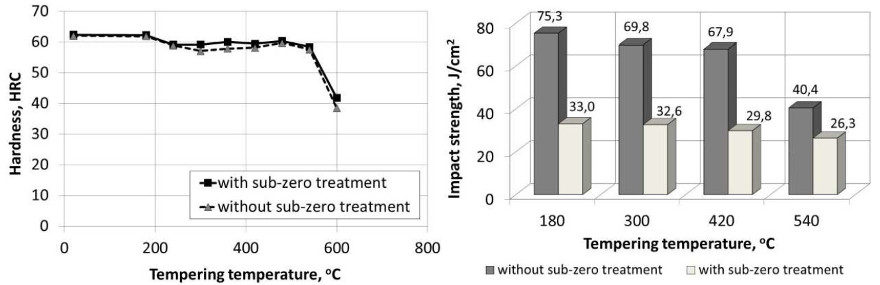
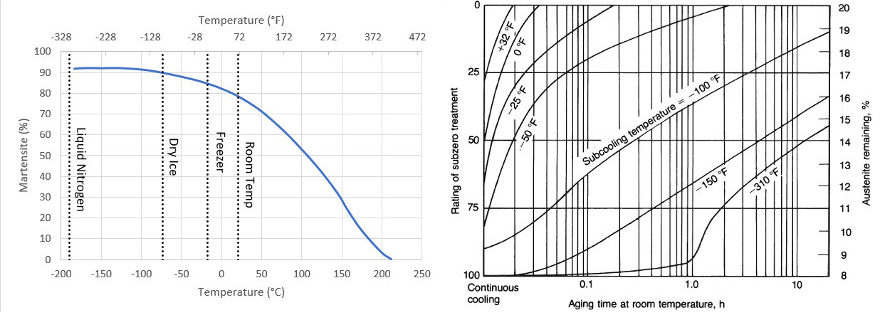
In Cryogenic Processing Part 1 I covered the effects of cryo on retained austenite and hardness. In Cryogenic Processing Part 2 I looked at the studies on cryo and toughness. Wear resistance is the most controversial aspect of cryogenic processing of steel. In particular there are claims that the use of cryogenic processing (liquid nitrogen) leads to an improvement in wear resistance that is not found with subzero processing (dry ice). Sometimes it is claimed that cryo can lead to massive increases in wear resistance [1]:
Introduction
Part 1 of the Cryogenic Processing series covered the transformation of retained austenite to martensite and the increase in hardness that occurs. That is the least controversial aspect of cryogenic processing of steel. The other two primary properties of steel affected by cryo processing are toughness and wear resistance. Both of these properties can be difficult to pin down as they have high variability. Tool steels are known for their relatively poor toughness which means we are often comparing small numbers.
Detour – Tempering
One important interrelation to keep in mind with subzero and cryo studies is the transformation of retained austenite in tempering. With sufficiently high tempering temperatures all/most of the retained austenite is transformed without any cold treatment. This depends on the alloy content, as low-alloy 52100 will have lost its retained austenite with a 500-600°F temper while high alloy steels need over 900°F. You can read more in the article on tempering. With high alloy steels the loss of retained austenite also coincides with “secondary hardening” which is a high temperature tempering treatment that increases hardness [1]:
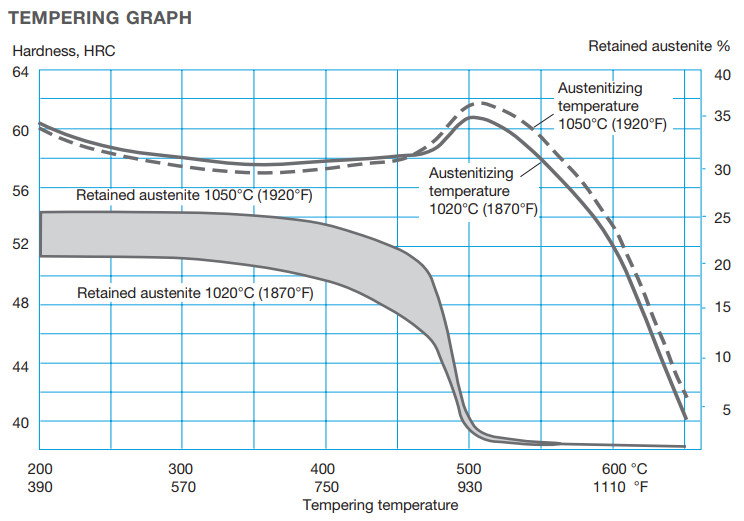
Above is a tempering chart for Caldie steel (0.7C-5.0Cr-2.3Mo) which shows both hardness vs hardening temperature and also retained austenite. You can see that at low tempering temperatures (<400°C) the retained austenite is basically constant. You can also see that the hardness decreases with higher tempering temperatures up to about 350°C and then it increases to a peak at around 520°C (950°F). Therefore tempering in the secondary hardening region above 400°C can lead to both high hardness and also the elimination of retained austenite.
Subzero or cryo processing prior to tempering also shifts the tempering-hardness curve to lower temperatures when using the secondary hardening range of tempering [2]:
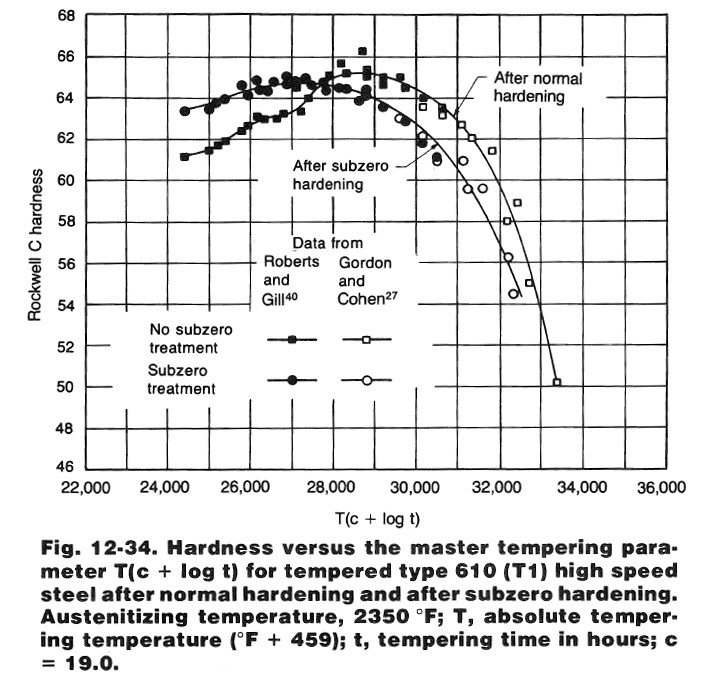
This means that in general, a lower tempering temperature is required to achieve the same hardness level with secondary hardening. Using the same tempering temperature as without a subzero treatment will lead to a greater degree of tempering. More tempering can be good or bad depending on the situation. Excessive tempering can lead to coarsening of tempering carbides which can reduce toughness. However, if the tempering was insufficient without subzero, the use of subzero processing may increase toughness due to shifting the “optimal toughness” range.
Toughness
In an earlier article where we tested the effects of heat treatment on Z-Wear toughness
Heat Treating and Austenitizing
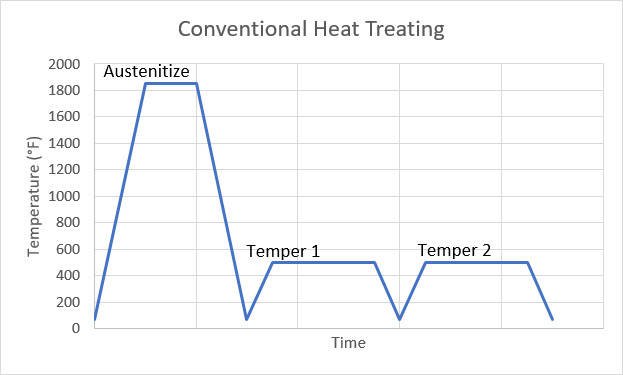
During heat treatment of steel, the steel is heated to a high temperature called the “austenitizing” temperature where a phase called austenite is formed. Steel has different phases which refer to different arrangements of iron atoms within the steel. Austenite has a different set of properties from the typical room temperature phase of steel. One example of the different properties of austenite is that it is non-magnetic unlike the room temperature ferrite or martensite.
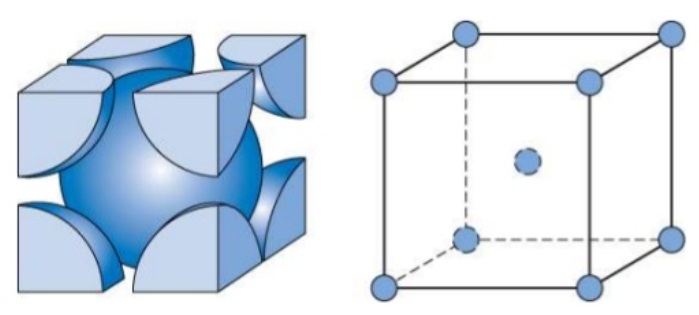
Room temperature iron/steel – Ferrite – Body Centered Cubic Atom Arrangement
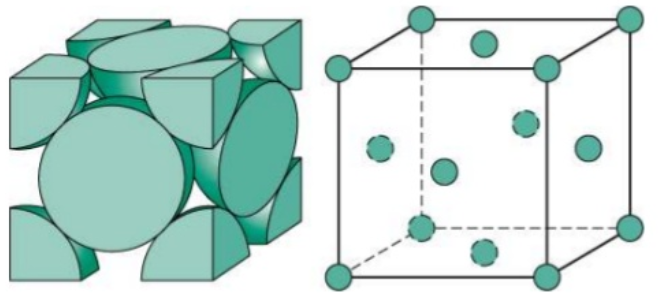
High temperature iron/steel – Austenite – Face Centered Cubic Atom Arrangement
After holding the steel at the high austenitizing temperature, the steel is then rapidly quenched which transforms the steel to a phase called martensite which has high hardness. It gains its high hardness because carbon is trapped in between the atoms which makes the room temperature phase martensite as opposed to the soft ferrite.
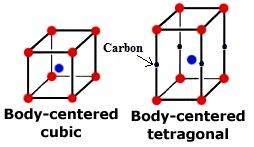
Normal soft room temperature ferrite on the left and hard martensite on the right
Background Information and CATRA Curves
Make sure you read Part 1 first so that you understand all of the background information for this article.
Below I have another Youtube video of CATRA testing so that you can see how the curves are generated during testing.
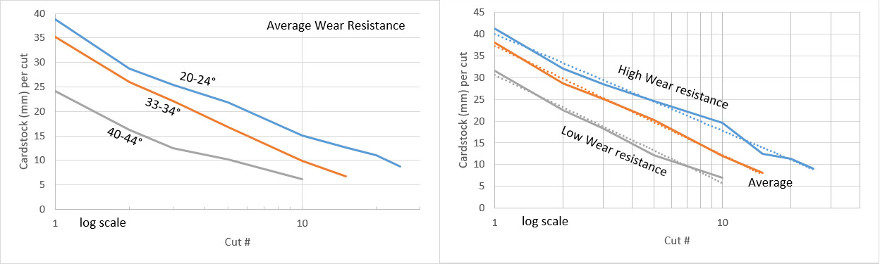
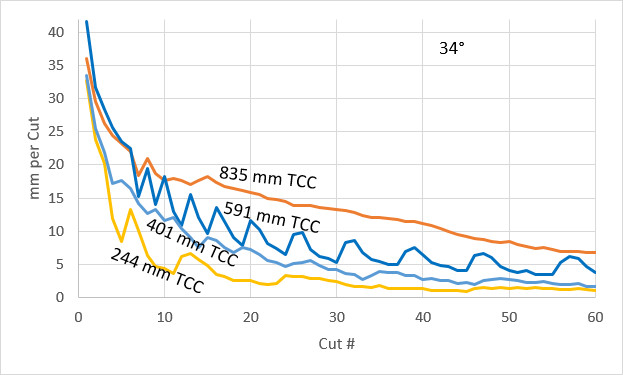
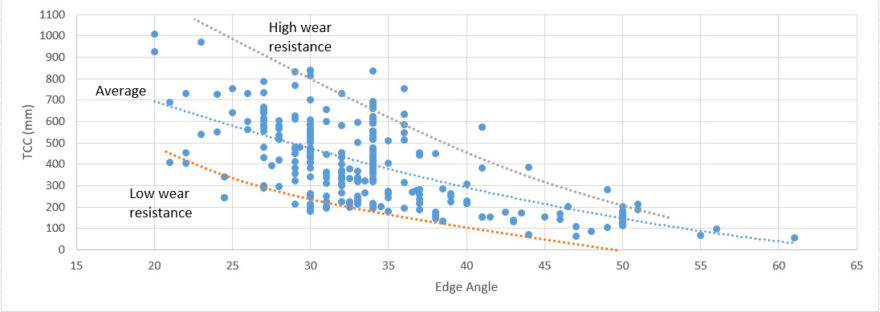
You can get a feel for how differently these steels cut by plotting a few of them together with the same edge angle. The top curve is a high wear resistance steel which cut 835 mm of cardstock after 60 cuts, which is the TCC value (Total Cardstock Cut). The 244 mm is a medium-low wear resistance steel which shows much more sharpness loss than the higher wear resistance steels.
Edge Radius During the CATRA Test
I’m not sure where in the test the average person would decide that the knife needs to be resharpened, but I would guess that it is before cut 60 because the CATRA test wears the edge pretty significantly. In CATRA tests performed by Verhoeven [1] the edge radius was reduced from ~0.5 micron all the way to 3-5 microns after only the second cycle (note he calls the cycles strokes):
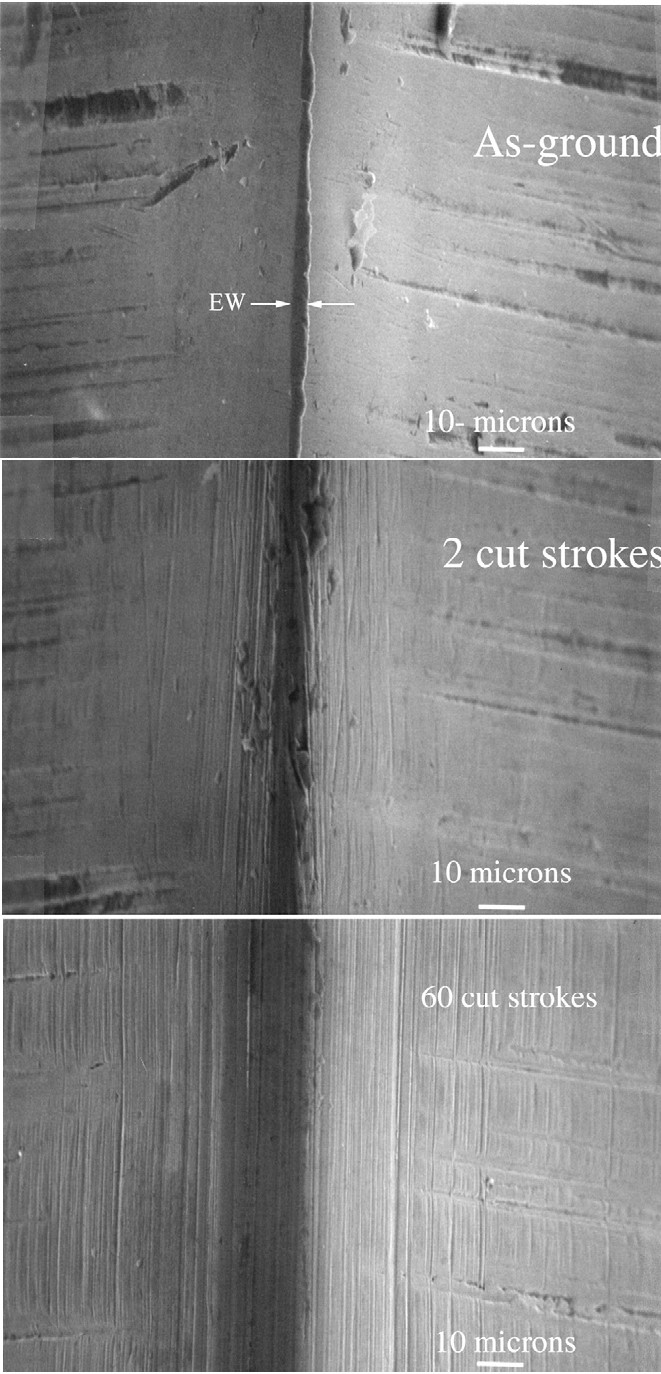
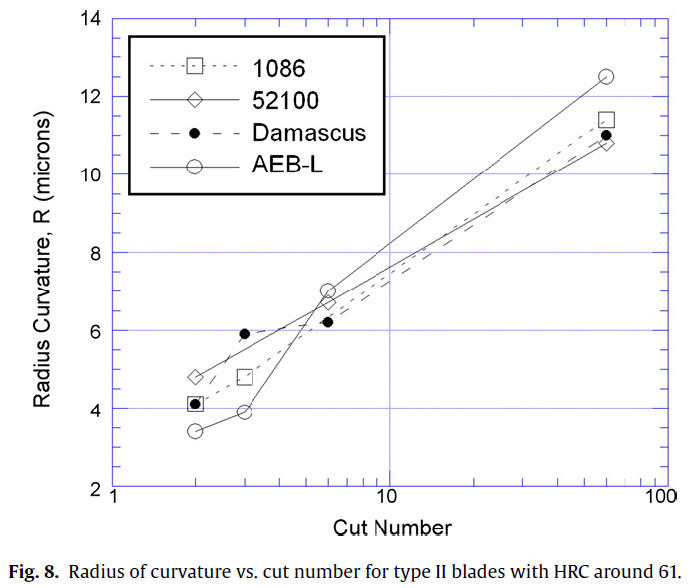
The tests performed by Verhoeven were with low wear resistance steels (AEB-L, 52100, 1086, and Wootz) but it still shows the relatively significant wear that occurs with the CATRA test. In the CATRA article on 154CM, it was found that the edge width (rather than radius measured by Verhoeven) was increased to 23 microns with a 20° edge angle and the 50° edge to 17 microns, which is quite dull. A ten micron edge width has been reported previously as a dull edge that needs sharpening [2].
Regression Factors Analysis
In part 1 I described the process by which we calculated the relative factors that affect edge retention which resulted in the equation below. CrC is a general term to refer to either Cr7C3 or Cr23C6 chromium carbides. CrVC is a general term to refer to M7C3 where M can be either Cr or V; when vanadium is added to a high chromium steel the chromium carbides are enriched with vanadium which increases the hardness of the Cr carbides. MC can refer to either vanadium carbides (VC) or niobium carbides (NbC). MN can refer to either vanadium nitrides (VN) or niobium nitrides (NbN). CrN refers to chromium nitrides. The formation of these particles is controlled primarily by the composition of the steel and secondarily by processing and heat treating. The equation below and the tables in Part 1 and here in Part 2 come from journal articles and books that have reported the carbide fractions after heat treatment.
TCC (mm) = -157 + 15.8*Hardness (Rc) – 17.8*EdgeAngle(°) + 11.2*CrC(%) + 14.6*CrVC(%) + 26.2*MC(%) + 9.5*M6C(%) + 20.9*MN(%) + 19.4*CrN(%)
Carbide Hardness
Taking an average value of the hardness of each carbide type we can compare between carbide hardness [3][4] and the calculated coefficient. Below I have plotted the carbide hardness in vickers (Hv) on the x-axis vs our calculated coefficient in the equation above for the relative contribution to edge retention for each carbide type. We get a very good correlation, demonstrating that carbide hardness strongly controls the effect of a carbide on slicing edge retention:
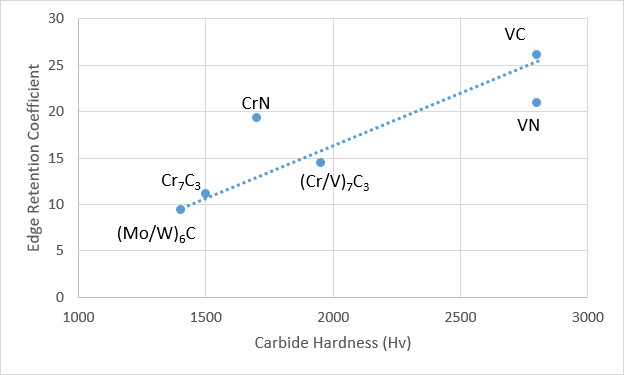
The coefficient for VC (listed as MC in the equation) is somewhat higher than the nitrogen version (VN or MN) despite their reported similar hardness [4]. Either the VN is actually somewhat softer or this is due to the VN coefficient being based on only two CATRA tests on one steel (Vanax 35). Either way it appears to be qualitatively accurate. Another possibility is that there may be some formation of V2N or chromium carbide/nitride which is lower in hardness than VN. The value for CrN also falls off the trend line of the others but that value comes from only one steel, Cronidur 30, and would likely change if further tests were performed. The M6C value is based on only two steels, CPM-M4 and M2, which both get wear resistance from VC so the accuracy of the M6C coefficient could definitely be improved with other high speed steels. No simple carbon steels with Fe3C cementite were tested which would be nice to add to the regression. Due to the low hardness of cementite it would be expected to have a relatively low value. This is confirmed by the Verhoeven study comparing 52100, 1086, and AEB-L where AEB-L with chromium carbides had superior edge retention to 52100 and 1086 with cementite [1]. If we extend the trendline in the plot above to the hardness of cementite we would estimate a coefficient of 5, or about half of chromium carbide. Experiments would be necessary to confirm that. Another interesting set of tests would be on the low-alloy tungsten steels such as the Blue series, V-Toku series, F2, O7, etc. The tungsten carbides in those steels are reported to be the very hard WC so it would be nice to know if that carbide improves edge retention to the same extent as VC. They are relatively niche steels so they have not received as much study as many tool steels and stainless steels. I wrote about these low-alloy tungsten steels
in an earlier article on this site
Knife Steel Nerds Patreon
Hardness and Megapixels
In the early-to-mid 2000’s with digital cameras and somewhat more recently with smartphone cameras we had the battle of megapixels. The number of megapixels is simply the number of pixels that are captured by a digital camera. When we had 0.3 megapixel cameras the pictures were quite blurry and jumping up to 2 or 3 megapixels made a big difference. However, when comparing 5 to 7 megapixels the quality of the image was much more likely to be controlled by the quality of the lens and sensor than simply the number of megapixels. Despite that, megapixels became an easy marketing point because it is a simple number to present to the public. We haven’t seen rockwell hardness climbing for no reason other than marketing, but it is one of the few simple numbers that are used to advertise for a knife. Therefore it is often misunderstood by knife buyers, and yes, even some knife makers. In this article I cover some simple reasons why hardness is not as important as other factors for predicting most steel properties. And then we get into the nitty gritty with why hardness is not always the same as strength and how heat treatment can affect strength independent of hardness.
Intro to Rockwell Hardness
Rockwell hardness is a simple test for checking the relative strength of materials. It works by indenting steel with a fixed load and measuring the distance that the indenter travels into the steel. It is commonly used by knifemakers, heat treaters, and knife companies. Often the hardness value or a range of hardness is given along with a knife, ie 58-60 Rc or 59 Rc. Hardness correlates well with strength, which tells us how resistant the material is to permanently deforming. With thin edges on knives, resistance to deformation is important to avoid rolled edges. Higher hardness also correlates with higher wear resistance and lower toughness. However, there are times when this hardness value can be misleading. I have summarized a few of those cases below:
Toughness
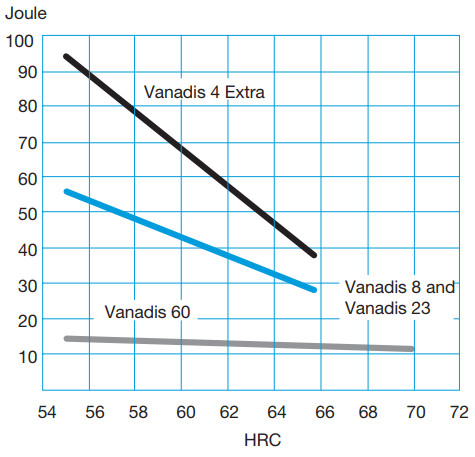
Higher hardness/strength reduces the toughness of steel. Toughness is the resistance to fracture or chipping which you can read more about in this article. However, there are more factors that control steel toughness than just hardness. For one major example, the amount and size of carbides present in steel greatly controls the toughness of steel, as carbides are very hard brittle particles that promote fracture [1]. Therefore, hardness cannot be used as a proxy for toughness. A 62 Rc steel of one type may be tougher than another at 58 Rc.
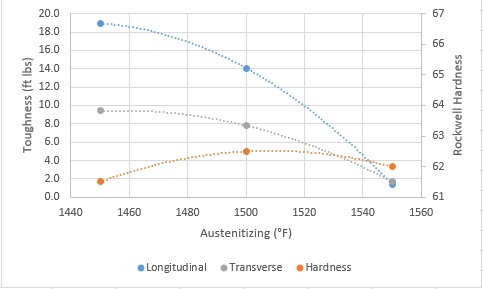
Even if we focus on only one steel type, different heat treatments can lead to different levels of toughness at the same hardness. If a steel is austenitized at too-high a temperature, toughness can be greatly reduced. You can read more in this article on austenitizing. In our toughness testing of CruForgeV, we even found a rather sharp drop in toughness even when using an austenitizing temperature recommended by the datasheet, from 14 ft-lbs with 1500°F austenitize to less than 2 ft-lbs with 1550°F:
Wear Resistance
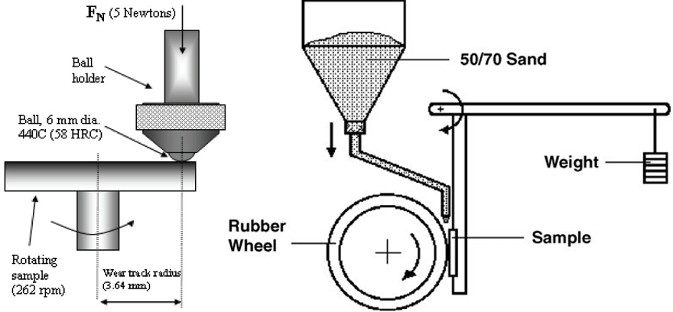
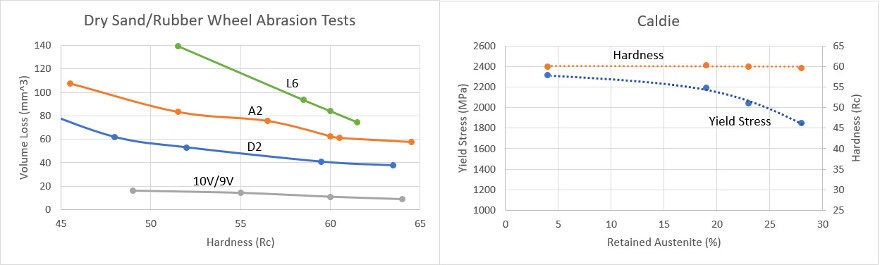
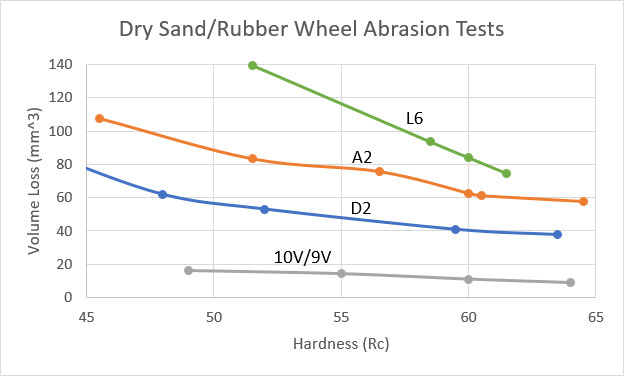
Higher hardness increases wear resistance [2][3][4][5]. However, just like toughness the carbides cannot be ignored. The high hardness of carbides leads to improved wear resistance even when the steel may be at a lower hardness. Wear resistance correlates with slicing edge retention. Therefore, hardness should not be used as a proxy for wear resistance. L6 is a low alloy steel with relatively soft iron carbides (cementite). A2 and D2 contain harder chromium carbides but D2 with its 15% carbide is more wear resistant than A2 which has about 1/3 as much carbide. 10V and 9V have a similar amount of carbide as D2 but have the much harder vanadium carbide for better wear resistance. Cementite is about 1000 on the Vickers hardness scale, chromium carbide 1500 Hv and vanadium carbide 2800 Hv [6]. Note that in the plot below lower is better.
Tensile and Compression Testing
Hardness correlates well with strength. A more complete strength test is called the tensile test where a bar of steel is pulled until it breaks. A compression test is similar but usually uses a cylinder and the steel is compressed until it breaks. The two stress-strain “curves” end up looking similar except for brittle materials which fail prematurely in a tensile test.
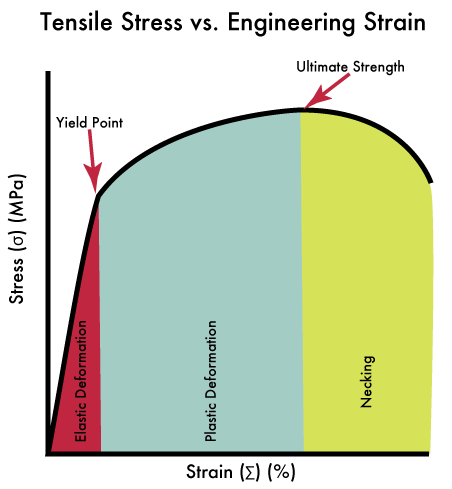
There are three things I want to point out in the tensile test: elastic deformation, yield point, and ultimate stress/strength. Elastic deformation is the period where flexing or pulling a piece of steel and letting go allows it to return to its original position. I wrote all about this behavior in Why Doesn’t Heat Treating Affect Steel Flex? At the yield point the steel permanently, or plastically deforms, so that when you let go the steel doesn’t return to its original shape but stays deformed. The stress (load divided by cross section) required to reach the yield point is the yield stress. The ultimate stress is the stress required to break the material. If we think about this in terms of a knife edge being pressed into a rod, we see the same three regions:
This is all important because we need to understand what the hardness test is showing us. Hardness of steel usually correlates very well with both yield stress and ultimate stress. However, there are certain cases where yield stress and ultimate stress do not correlate with each other. A steel may have a low yield stress so it is relatively easy to deform but a high ultimate stress. In that case which is the hardness test measuring?
Retained Austenite
When steel is heat treated it is heated up to a high temperature where a phase called austenite is formed, followed by quenching the steel rapidly to form the hard phase called martensite. In certain cases a certain amount of austenite is “retained” after quenching.
Learn more about quenching and retained austenite in this article